
Best International Payment Gateway for ecommerce
Choosing the right international payment gateway can affect more than whether a customer completes a purchase. For ecommerce businesses selling across borders, the gateway shapes which payment methods you can offer and how much you lose to currency conversion.
It also affects how many orders actually get authorized, how well you catch fraud, and how smooth checkout feels to a first-time buyer.
There isn’t one best gateway for every international ecommerce business. The right choice depends on where you sell, which currencies your customers pay in, the platform your store runs on, your order volume, and how much you’re really paying once processing and FX fees are added together.
This guide breaks that decision down clearly, compares the six gateways worth shortlisting in 2026, and shows you how to match a provider to your specific business — not just hand you a generic ranking.
Before switching providers altogether, it’s worth running an ecommerce payment gateway audit to confirm whether your current problems actually come from the gateway itself.

Quick Comparison: Best International Payment Gateways
Here’s the shortlist at a glance before we go deeper into each one.
| Payment Gateway | Best For | International Coverage | Local Payment Methods | Ecommerce Integration | Pricing |
|---|---|---|---|---|---|
| Stripe | Developers & growing e commerce | Broad | Strong | Excellent | Transaction-based |
| Adyen | Enterprise / global brands | Broad | Strong | Excellent | Custom |
| PayPal | Fast launch & buyer trust | Broad | Strong | Excellent | Transaction-based |
| Airwallex | Multi-currency e commerce | Broad | Strong | Strong | Transaction-based |
| Shopify Payments | Shopify merchants | Market-dependent | Market-dependent | Native | Plan/region dependent |
| Checkout.com | High-volume global e commerce | Broad | Strong | Strong | Custom |
Pricing and currency availability change often, so verify exact numbers directly on each provider’s official pricing page before you commit. Compare the fine print before you sign, not after your first international order settles.
What Is an International Payment Gateway?
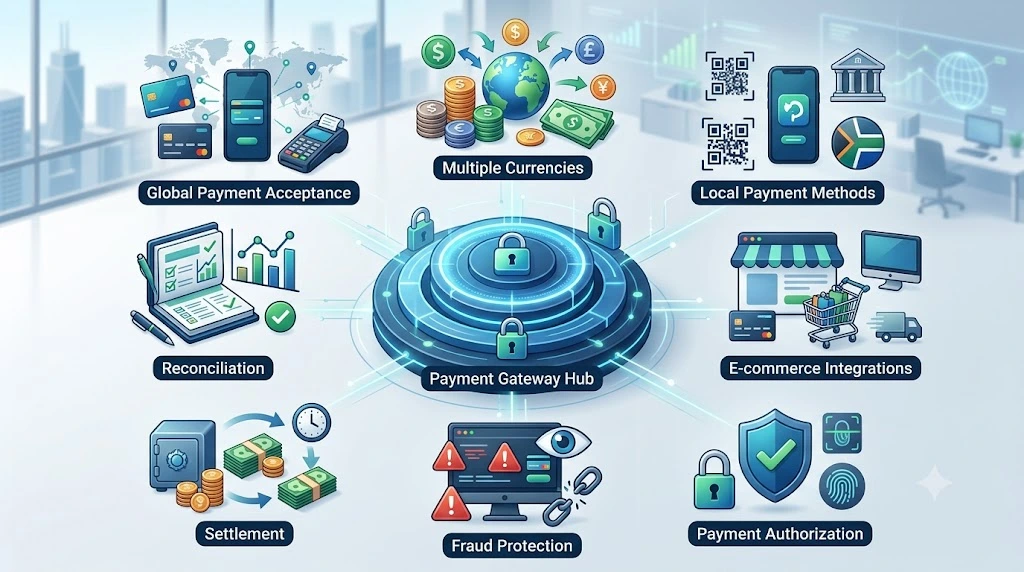
A payment gateway is the technology layer that captures a customer’s payment details at checkout and passes them securely to be authorized. An international payment setup is designed to support cross-border selling through multiple currencies, regional payment methods, and international card networks.
It’s worth knowing the difference between a gateway, a processor, and a merchant account. The gateway captures the transaction, the processor moves it through the card networks, and the merchant account (or acquiring bank) actually receives the funds. Many modern providers bundle all three into one product, which is part of why the market can feel confusing.
What Makes a Good International Payment Gateway?
Before ranking providers, it helps to know what you’re actually evaluating. These are the factors that separate a gateway that fits your business from one that quietly costs you sales and margin.
Country and Merchant Availability
Check where your business is legally allowed to register as a merchant, and separately, which customer countries the gateway can process payments from. These two lists are rarely identical.
Currency Support
Look at presentment currencies (what the customer sees), settlement currencies (what lands in your bank account), and whether the provider offers multi-currency balances so you’re not converting on every single sale.
Local Payment Methods
Cards aren’t the whole story internationally. Digital wallets, local bank methods, and region-specific payment options can be important in markets where cards aren’t the dominant online payment method.
Total Payment Cost
Don’t stop at the headline transaction fee. International card fees, cross-border fees, FIX markups, payout fees, refund fees, and charge-back fees all add up — and the gateway with the lowest advertised rate isn’t always the cheapest in practice.
Authorization and Checkout Performance
A gateway’s real value shows up in its approval rate. Local acquiring, smart 3D Secure handling, and retry logic can be the difference between a completed sale and an abandoned cart.
Ecommerce Integrations
Confirm native or well-supported plugins for Shopify, Woo Commerce, Magento, or your custom stack — a clunky integration creates friction long before a customer even reaches checkout.
Fraud and Charge-back Management
Cross-border transactions can introduce additional fraud and risk-management challenges. Built-in risk scoring, 3D Secure authentication, and dispute management tools matter more here than for a purely domestic store.
Any gateway you shortlist should also meet current PCI DSS compliance requirements for handling card data.
Settlement and Reconciliation
Ask how often you get paid, in which currencies, and how easy the reporting is to reconcile against your accounting software — this becomes a daily operational headache if it’s overlooked upfront.
How We Compare International Payment Gateways
We compare each provider using a consistent framework covering capabilities, performance, integrations, pricing, scalability, and real-world fit, rather than ranking by name recognition alone. See our How We Test & Score Tools methodology for the full evaluation approach behind every gateway below.
6 Best International Payment Gateways for Ecommerce
Here’s how the six strongest options actually compare, business type by business type.
1. Stripe — Best for Flexible E commerce and Developer-Led Businesses
Stripe supports payments across a large number of countries and currencies, with deep documentation that makes custom checkout builds straightforward. It covers major card networks, popular wallets, and dozens of local payment methods, plus native plugins for the major e commerce platforms.
Pricing is transaction-based and scales with volume, which suits small-to-mid-sized stores well. The trade-off is that very high-volume or highly complex merchants may eventually want custom enterprise terms Stripe doesn’t offer by default.
2. Adyen — Best for Large Global Ecommerce Businesses
Ad yen is built for scale, offering local acquiring in many regions, which tends to lift authorization rates for global brands. It bundles strong risk management tools and a single platform for cards, wallets, and local methods worldwide.
Pricing is custom and negotiated, which usually only makes sense once you’re processing significant volume. Smaller merchants may find on-boarding and setup heavier than they need.
3. PayPal — Best for Fast Setup and Buyer Familiarity
PayPal remains one of the fastest gateways to launch with. PayPal’s widely recognized wallet can be useful for merchants that want to offer a familiar payment option at checkout. It supports cards and its own wallet across most major markets.
Currency conversion can add a meaningful cost for international sellers, so high-volume merchants should model PayPal’s current FX and conversion costs before choosing it as their primary option.
4. Airwallex — Best for Multi-Currency E commerce
Airwallex is built around holding and settling funds in multiple currencies. It can help e commerce brands reduce unnecessary currency conversions by supporting multi-currency collection and like-for-like settlement where available.
It also supports a strong range of local payment methods and integrations with major e commerce platforms, making it a strong pick for stores actively expanding into several countries at once.
5. Shopify Payments — Best for Shopify Stores
For merchants already on Shopify, Shopify Payments is the path of least resistance — it’s built natively into checkout with no separate integration required. Currency and local method support vary by region, so coverage should be checked against your specific target markets.
It’s an easy default for Shopify stores just starting to sell internationally. Stores with more complex international payment requirements may evaluate additional payment providers, depending on their Shopify plan, market, and payment setup.
If you’re still deciding which platform to build on in the first place, compare the best ecommerce platform for small businesses before committing to a payment stack.
6. Checkout.com — Best for High-Volume Global E commerce
Checkout.com targets high-volume global merchants with local acquiring, a strong API, and enterprise-grade fraud tools. It’s built to handle complex, high-transaction operations rather than smaller storefronts.
Its custom pricing and enterprise-oriented setup are generally better suited to merchants processing significant international volume.
International Payment Gateway Fees Explained
“Fees” is where most comparisons stop short. Here’s what actually makes up your real cost.
Transaction fees are the base percentage (plus sometimes a flat fee) charged per successful payment. International or cross-border fees may apply depending on the provider, card, transaction route, and merchant location.
Currency conversion and FX fees hit whenever a payment is converted between currencies — often the biggest hidden cost. Cross-border fees can stack on top of both of the above, depending on the provider.
Refund and chargeback costs vary by provider and transaction type, so check the current fee schedule before comparing gateways. Settlement and payout costs can include fees for moving money to your bank or converting it at payout time.
If your current payment processing fees don’t add up to what you expected, that gap is usually hiding in one of these categories.
A simple example: on a $100 international order, you might lose a percentage to the base transaction fee, another slice to an international card fee, more to FX conversion, and possibly a final cut at settlement. Individually small, these add up to a meaningfully different number than the advertised rate.
How Much Can an International Payment Gateway Cost?
The advertised transaction rate is rarely your actual cost. A more honest formula looks like this:
Total payment cost = processing fee + international/cross-border fee + FX cost + other transaction costs
Two gateways with the same headline rate can end up costing very differently once FX and cross-border fees are factored in. Before committing, run this formula against your actual order mix — average order value, top customer countries, and currency spread — rather than relying on the marketing page alone.

Which International Payment Gateway Is Best for Your E commerce Business?
There’s no single winner — only the right fit for your business type.
| Business Type | Recommended Option |
|---|---|
| Small/medium e commerce | Stripe |
| Shopify store | Shopify Payments |
| Multi-currency e commerce | Airwallex |
| Enterprise/global brand | Adyen |
| Fast launch + wallet payments | PayPal |
| High-volume global e commerce | Checkout.com |
Stripe fits businesses that want flexibility without heavy negotiation. Shopify Payments makes sense simply because it’s already built into your platform.
Airwallex earns its place when currency conversion is eating into your margins across several markets. Adyen justifies its setup effort once your scale demands local acquiring everywhere you sell.
PayPal wins on trust and speed to launch. Checkout.com is worth the enterprise-level setup once volume alone drives meaningful savings.
How to Choose an International Payment Gateway
Work through these steps in order rather than comparing gateways feature-by-feature in isolation.
- List your target countries — where your customers actually are, not where you’d like to sell.
- Identify customer payment methods — cards, wallets, and local rails preferred in those markets.
- Compare currencies and settlement — presentment vs. settlement currency, and .
- Calculate your effective payment cost — using the total-cost formula above, not the headline rate.
- Check ecommerce platform compatibility — confirm native or well-maintained plugin support.
- Evaluate fraud and chargeback tools — especially if you’re entering higher-risk regions.
- Check payout and reconciliation — how funds land and how easily they match your books.
- Verify merchant eligibility — some providers restrict onboarding by business type or country.
International Payment Gateway vs Payment Processor
These two terms get used interchangeably, but they describe different jobs.
| Payment Gateway | Payment Processor | |
|---|---|---|
| Main role | Captures payment info at checkout | Moves the transaction through card networks |
| Customer-facing | Often, yes | Usually no |
| Authorization | Connected to the process | Handles the processing flow itself |
| Example role | Checkout/connection layer | Behind-the-scenes processing layer |
Payment Gateway vs Payment Aggregator: What’s the Difference?
A payment gateway is the technology layer that securely passes payment information for authorization. A payment aggregator or payment service provider can bundle gateway, processing, onboarding, and other payment services into a single offering.
Aggregators typically group many small merchants under one master merchant account, which speeds up onboarding but can mean less control and stricter transaction limits. A dedicated payment setup can provide greater control and customization as you scale, making it more suitable for growing ecommerce businesses with complex payment needs.
Common Mistakes When Choosing an International Payment Gateway
Choosing based only on transaction fees ignores FX, cross-border, and payout costs that often matter more. Ignoring FX costs is the single most common way merchants underestimate their real payment expense.
Checking currency support but not settlement support leaves you unable to actually receive funds the way you expected. Ignoring local payment methods means losing conversions in markets where cards aren’t the default choice.
Choosing a gateway that doesn’t support your business entity can derail onboarding entirely, sometimes after weeks of setup. Ignoring chargebacks and fraud tools leaves cross-border stores especially exposed. Not testing checkout in target markets means launching blind to real friction your customers will hit.
Before replacing a provider over failed payments or unexpected fees, run a payment gateway audit to determine whether the real issue is the provider, your configuration, or the checkout implementation itself.

Frequently Asked Questions
What is the best international payment gateway?
There isn’t a single best option — Stripe suits most growing ecommerce stores, Adyen suits enterprise brands, and Airwallex suits multi-currency operations. The right pick depends on your markets and volume.
What is the best payment gateway for international ecommerce?
For most ecommerce businesses starting to sell abroad, Stripe or Shopify Payments (if already on Shopify) offer the best balance of ease and coverage. Higher-volume sellers should compare Adyen or Checkout.com.
Which payment gateway supports the most countries?
Adyen and Stripe both offer very broad country and currency coverage, though exact numbers change over time and should be confirmed on each provider’s current site.
Which international payment gateway has the lowest fees?
No provider is universally cheapest — it depends on your order volume, currency mix, and card networks. Always calculate total payment cost, not just the headline transaction rate.
What payment gateway is best for Shopify international stores?
Shopify Payments is the simplest native option. Stores with more complex international payment requirements may evaluate additional providers like Stripe or Airwallex, depending on their plan, markets, and setup.
Can ecommerce businesses accept payments in multiple currencies?
Yes. Most modern gateways, especially Airwallex, Stripe, and Adyen, support multi-currency pricing, presentment, and in some cases multi-currency settlement balances.
What is the difference between an international payment gateway and a payment processor?
A gateway captures and passes along payment details at checkout, while a processor moves that transaction through the card networks for authorization. Many providers now combine both roles into one product.
How much do international payment gateways charge?
Costs typically combine a base transaction fee, an international or cross-border fee, and an FX conversion cost — together, not separately. The true cost is usually higher than the advertised headline rate alone.
Final Verdict
If you need a starting point, Stripe is the strongest all-round option for many growing ecommerce businesses — but the best choice still depends on your markets, platform, payment mix, and transaction volume. Adyen is worth the setup once you’re operating at enterprise scale.
Airwallex earns its spot for stores managing several currencies at once. PayPal remains hard to beat for buyer trust and fast setup.
Shopify Payments is the obvious default for Shopify-native stores. Checkout.com makes sense once your global order volume is genuinely high.
Whichever you choose, run the total-cost formula against your own numbers before deciding — the right gateway is the one that fits your markets, your platform, and your margins, not the one at the top of someone else’s list.