
How to Reduce Customer Acquisition Cost for D2C Brands
To reduce customer acquisition cost for D2C brands, start with the gap between what you spend and how many first-time buyers that spend brings in. Better product pages, fewer checkout failures, useful ad creative, and careful budget allocation can help you acquire customers more efficiently.
Cutting an unprofitable campaign can be the right decision. But cutting every campaign equally may also remove the traffic that was working. The first job is to find the waste, then decide whether to fix it, test an alternative, or stop spending.
This guide covers 13 ways to improve acquisition efficiency and customer economics, a measurement framework, and an illustrative example. It also separates lower CAC from higher customer value: both matter, but they are different results.

What Is Customer Acquisition Cost?
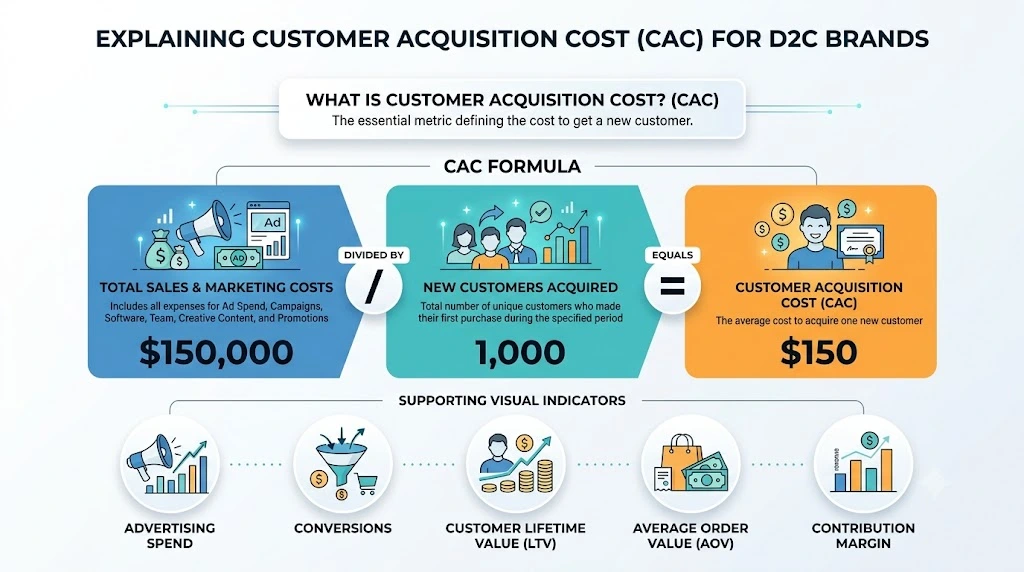
Customer acquisition cost, or CAC, measures how much you spend to acquire one new paying customer. A repeat order is valuable, but it is not another newly acquired customer.
How to Calculate Customer Acquisition Cost
CAC = Sales and marketing costs included in your calculation ÷ New customers acquired
If your monthly sales and marketing costs total $10,000 and you acquire 200 new customers, your CAC is $50.
Use the same reporting period for costs and customer acquisition. Where customers take longer to buy, also examine the delay between the initial marketing touch and the first purchase; a single calendar month may not tell the whole story.
What Costs Should Be Included in CAC?
A fully loaded calculation should account for advertising, creative production, agency or freelancer fees, relevant software, and the appropriate share of sales and marketing labor. Document how you allocate shared expenses so comparisons stay consistent.
For a total sales-and-marketing blended metric, include retention marketing costs too and label that scope clearly. If you calculate acquisition-only CAC, separate acquisition and retention expenses consistently rather than switching definitions between reports.
Product costs, shipping, payment fees, discounts, and returns also matter to profitability. Track their effect on net revenue and contribution margin without double-counting them as acquisition expenses.
CAC vs. CPA: What Is the Difference?
CPA measures the cost of a defined action, which could be a lead, signup, or purchase. CAC specifically concerns new paying customers. An ad platform’s cost per purchase may include returning buyers and exclude creative or agency expenses, so it is not automatically your fully loaded CAC.
What Is a Good CAC for a D2C Brand?
There is no universal dollar target. A replenishable skincare product and a mattress have different prices, margins, purchase cycles, and cash requirements.
Start with the contribution a customer produces after product and variable order costs. Then ask how long you can afford to wait to recover acquisition spending.
Evaluate LTV Using a Clear Definition
An LTV ratio compares customer value with acquisition cost. Define whether your LTV figure represents revenue, gross profit, or contribution after variable costs, and specify the observation period. These versions are not interchangeable.
Eightx’s DTC-focused analysis of LTV argues for evaluating customer contribution over a defined period instead of applying a generic 3:1 benchmark. This is a commercial CFO advisory firm’s analysis, not a universal industry standard.
For your own decisions, use observed customer cohorts, realistic repeat purchases, contribution margin, and cash available. Avoid funding today’s acquisition spending with optimistic lifetime revenue projections.
Lower CAC vs. Better Customer Economics
If you spend $10,000 to acquire 200 customers, CAC is $50. If those same customers place larger orders or buy again, that original acquisition cost is still $50 per customer.
Higher average order value and retention can improve contribution, LTV, and payback. They lower measured CAC only if acquisition costs fall or the number of new customers increases relative to the relevant spending.
Why Is Your Customer Acquisition Cost So High?
Look for a measurable problem before choosing a tactic:
| Possible problem | What to investigate |
|---|---|
| Weak product-page conversion | Product clarity, delivery information, mobile usability, and qualified traffic |
| Checkout abandonment | Unexpected charges, payment failures, forced account creation, and form friction |
| Rising advertising costs | Changes in auction prices, creative performance, audience mix, and seasonality |
| Poor targeting or positioning | Whether visitors understand the product and have a reason to buy |
| Creative fatigue | Performance changes by creative, placement, audience, and frequency |
| Unreliable measurement | Returning customers counted as new, duplicated conversions, and missing costs |
| Dependence on one channel | Exposure to a single platform’s cost changes and limited alternatives |
Weak retention is a related profitability problem. It makes acquisition harder to recover, but does not by itself change the cost of acquiring the original customer.
How to Reduce Customer Acquisition Cost for D2C Brands
The tactics below have different roles. Conversion improvements and efficient acquisition channels can directly affect CAC. AOV and retention primarily improve what customers contribute after acquisition.
1. Improve Your Website Conversion Rate
Start with a product page that receives meaningful traffic but generates few first purchases. Make the product’s purpose, price, delivery expectations, return conditions, and evidence of quality easy to understand.
For example, a skincare page could explain texture, ingredients, suitability, and how to use the product beside the purchase button. Test a specific change rather than redesigning every element at once.
Measure: First-purchase conversion rate and CAC, with refunds and contribution per order as guardrails. A higher overall conversion rate driven by returning buyers does not necessarily mean better acquisition.
2. Fix Funnel and Checkout Friction
Review the journey from product page to successful payment on mobile. Check when shipping charges appear, whether guest checkout works, and whether payment failures have useful recovery messages.
If customers start checkout but fail to finish, investigate the largest drop-off before paying for more traffic. Use the payment gateway audit checklist to review payment and checkout issues.
Measure: Checkout completion, payment success, and new-customer conversion by device. Distinguish technical failures from customers choosing not to proceed.
3. Improve Paid Ad Targeting
Check whether campaigns reach people you can serve profitably. Exclude unsupported delivery regions and separate existing buyers from prospecting where platform settings allow it.
Do not assume the narrowest audience will perform best. Test a relevant broad audience against a more specific one with comparable creative and offers. Tiny audiences can limit delivery and increase costs.
Measure: Cost per verified new customer, customer quality, and contribution after acquisition. Click-through rate alone cannot tell you whether targeting is profitable.
4. Test and Refresh Ad Creative
Build tests around specific buying questions: what the product does, how it works, what makes it different, and why its price is reasonable. Change one major angle at a time so results are interpretable.
A homeware brand might compare a product demonstration with a customer explanation of everyday use. Keep the landing page and offer consistent where possible, and allow enough purchases to accumulate before declaring a winner.
Measure: New-customer CAC alongside click-through rate and landing-page conversion. More clicks are useful only when they lead to suitable buyers.
5. Retarget High-Intent Visitors Carefully
Separate visitors who viewed a product from those who began checkout. Match follow-up messages to the likely obstacle, such as delivery uncertainty or unanswered product questions, rather than immediately offering a discount.
Exclude recent purchasers from acquisition retargeting where possible and respect applicable consent requirements. Retargeting can claim credit for people who would have purchased anyway; a low reported CPA is not proof of additional sales.
Measure: First-time purchases, frequency, blended CAC, and incremental lift where a holdout test is feasible. Keep the budget proportionate to the audience.
6. Increase Average Order Value Without Sacrificing Margin
Offer genuinely complementary bundles or an appropriate shipping threshold. Check whether the added revenue covers the extra product cost, fulfillment, shipping subsidy, and any discount.
For example, pairing a cleanser with a refill may produce more contribution than discounting the cleanser alone. But an expensive bundle that discourages first-time buyers could also reduce conversion and raise CAC.
Measure: AOV, contribution per order, first-purchase conversion, and CAC. Higher AOV improves order economics; it does not automatically lower acquisition cost.
7. Improve Repeat Purchases and Retention
Use clear order updates, product-use guidance, and relevant replenishment reminders. Time follow-ups around the product’s actual purchase cycle and avoid sending every customer the same promotion.
A consumable brand can test a reminder near the likely refill date, then compare repeat contribution with a similar group that did not receive it. See these customer retention strategies for small D2C brands for additional approaches.
Measure: Cohort repeat purchase rate, repeat contribution after campaign costs, unsubscribes, and payback. Retention improves customer value and reduces reliance on new customers for revenue; it does not retroactively reduce original CAC.
8. Build Organic Acquisition Through SEO and Content
Create content that helps a potential buyer make a relevant decision: product comparisons, sizing guidance, care instructions, or answers to common pre-purchase questions. Link naturally to the product or category that addresses the need.
For example, a bedding brand could explain how to choose sheets for a warm bedroom. Assess whether that content attracts potential customers, not just readers with no buying relevance.
Measure: New customers and contribution associated with organic discovery over time. Include content, editing, and SEO expenses; organic traffic has no direct ad click charge, but it is not free or guaranteed to convert.
9. Use Referrals and Word-of-Mouth
Make referral terms easy to understand and reward qualifying purchases rather than raw invitations. Set rules for self-referrals, canceled orders, and returns before launching.
Start with satisfied customers and an incentive your margin can support. Include referral software and rewards in the economics, accounting for discounts consistently rather than counting them twice.
Measure: Cost per new referred customer, contribution after incentives, fraud, and repeat purchase behavior. Referral customers are not automatically cheaper after rewards.
10. Use UGC and Creator Content
Ask creators or customers to demonstrate the product in realistic situations and address specific objections. Secure permission and advertising usage rights before repurposing their content, and disclose paid relationships where required.
Begin with a limited test instead of a large commitment. Compare creator content with existing creative under similar campaign conditions, including creator fees and editing expenses in your assessment.
Measure: Fully costed new-customer acquisition, conversion, and contribution. Views and engagement are supporting signals, not proof of profitable acquisition.
11. Diversify Acquisition Channels Gradually
Test one additional channel that fits how your customers discover products. Search may suit an existing need, while a creator partnership may help explain an unfamiliar product.
Set a test budget you can afford to lose and a clear review point. Spreading a small budget across many platforms can produce too little evidence on any of them. Diversification reduces concentration risk; it does not guarantee lower CAC.
Measure: New-customer acquisition cost, total additional costs, contribution, and evidence that the channel adds customers beyond those already reached elsewhere.
12. Use First-Party Data for Better Segmentation
Use consented customer data to understand which products, first orders, and purchase journeys are associated with healthier contribution. Keep acquisition reporting separate from campaigns aimed at repeat buyers.
For example, if a starter kit attracts customers who later reorder profitably, test a clearer starter-kit acquisition offer. Avoid uploading sensitive information or using customer data beyond the permissions and rules that apply.
Measure: CAC and contribution by acquisition cohort, supported by repeat behavior over a consistent observation period. Do not judge a new cohort against one that has had much longer to reorder.
13. Reallocate Budget Using Marginal Performance
Compare what the next increment of spending produces, not just a channel’s historical average. A campaign can look profitable at a small budget and become less efficient as spending rises.
Increase budgets in controlled steps, then check additional new customers and contribution. Reduce or pause campaigns when the evidence shows unacceptable losses; allow for attribution delays and normal variation before reacting to a single bad day.
Measure: Incremental acquisition spending divided by incremental new customers where you can estimate them reliably, plus payback and total contribution. Platform attribution alone may overstate the result.
How to Reduce CAC Without Cutting Your Marketing Budget
At a fixed $10,000 acquisition cost, increasing new customers from 200 to 300 reduces CAC from $50 to $33.33. The reduction comes from acquiring more customers for the same cost.
If you spend extra on creative, tools, or services to achieve that improvement, include those expenses before calculating the final CAC. A flat media budget does not necessarily mean flat total acquisition costs.
Keeping the budget unchanged is an option, not a requirement. If campaigns are losing money or cash is tight, cutting waste can be more useful than preserving the spending level.
How to Measure CAC More Accurately
Paid CAC vs. Blended CAC
Paid CAC focuses on new customers attributed to paid acquisition. State whether its numerator includes only media spend or also associated creative, agency, and labor costs.
Blended CAC combines the costs within your stated sales-and-marketing scope and divides them by all new customers. Eightx’s explanation of blended CAC versus paid CAC provides additional context on these reporting views.
Neither number replaces the other. Use channel reporting for diagnosis and blended reporting to check overall efficiency. Keep cost definitions stable.
Separate New and Returning Customers
Use your store or customer records to identify first-time buyers. Do not sum platform-reported purchases and assume they are unique new customers; several platforms may claim the same sale.
Apply consistent rules for canceled, fraudulent, and refunded first orders. Report refund behavior alongside acquisition performance so low-quality orders do not make a campaign look healthier than it is.
Compare Channels, Campaigns, and Cohorts
Break results down by channel and campaign, then examine contribution by acquisition cohort. Document attribution windows and delays. If a channel’s apparent performance changes, check tracking and customer mix before changing the entire budget.
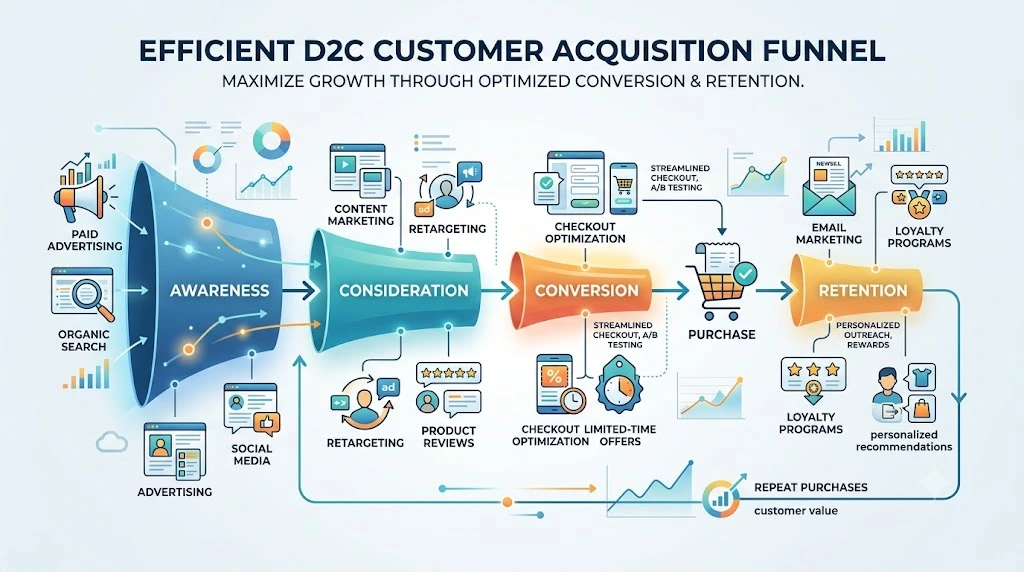
Metrics to Track Alongside CAC
| Metric | What it helps you understand |
|---|---|
| CAC | Cost of acquiring a new customer within the stated cost scope |
| Customer value over a defined period | Revenue or contribution generated by a cohort; label the basis clearly |
| LTV | Customer value relative to acquisition cost using compatible definitions |
| First-purchase conversion rate | How effectively relevant visits become new customers |
| AOV | Revenue per order, which must be evaluated alongside margin |
| Repeat purchase rate | Whether customers return within the observation window |
| ROAS | Attributed advertising revenue relative to ad spend, not profit |
| CAC payback period | Time until accumulated customer contribution recovers acquisition cost |
| Contribution after acquisition | Amount remaining after the defined variable costs and acquisition expense |
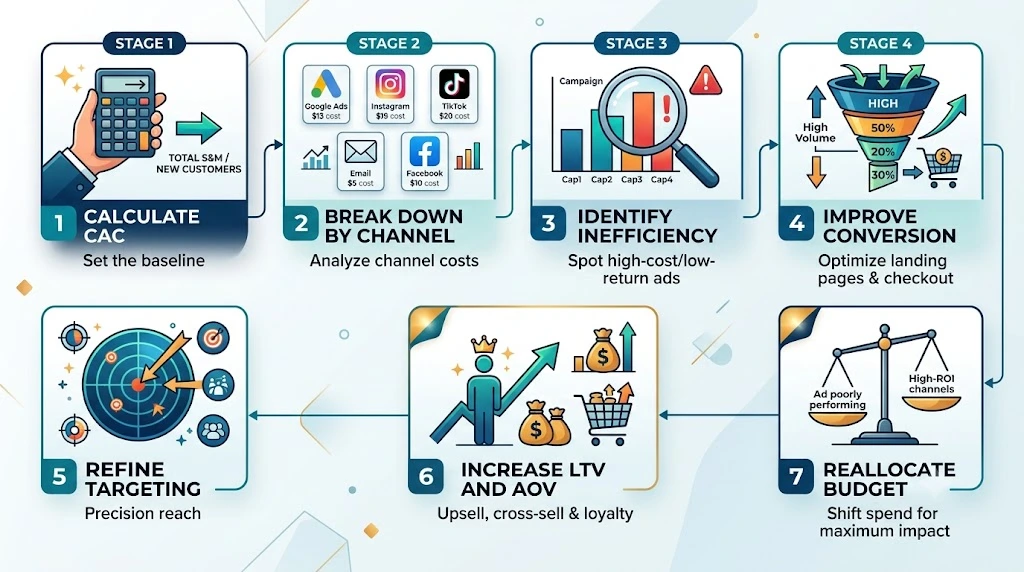
A 7-Step Framework to Reduce Customer Acquisition Cost
- Define your baseline. Record costs, unique new customers, CAC, and the period measured.
- Find the largest problem. Review channels and the journey from landing page to payment.
- Choose one test. State what you will change and why it could improve first-time purchases.
- Set guardrails. Define the budget, observation period, acceptable contribution, and reasons to stop.
- Measure the result. Include implementation costs and check new customers, not just orders.
- Review customer economics separately. Assess AOV, repeat contribution, and payback without calling them CAC reductions.
- Adjust and repeat. Expand effective changes carefully, revise inconclusive tests, and stop unprofitable activity.
Illustrative Example: Reducing CAC for a D2C Brand
This is a hypothetical calculation, not a documented brand case study or a promised result. Assume both periods use the same cost definition and include all relevant acquisition expenses.
| Measure | Before | After |
|---|---|---|
| Total acquisition costs | $20,000 | $20,000 |
| New customers acquired | 400 | 550 |
| CAC | $50.00 | $36.36 |
In this scenario, suppose improved product information, fewer payment failures, and a better-performing creative mix bring in 150 additional new customers at the same total cost. CAC falls by approximately 27.3%.
The calculation demonstrates the relationship between spending and new customers. It does not prove which change caused the improvement; a real brand would need testing and attribution analysis to assess that.
If those customers also buy larger bundles or reorder, contribution and payback may improve further. Those benefits are separate from the CAC reduction shown in the table.
Common Mistakes That Make CAC Decisions Worse
- Counting returning buyers as newly acquired customers.
- Reporting media-only costs as fully loaded CAC.
- Treating higher AOV or retention as proof that CAC fell.
- Judging campaigns by ROAS without checking contribution and refunds.
- Calling organic or referral acquisition free while ignoring production and incentive costs.
- Increasing budgets based only on a channel’s past average performance.
- Changing several major variables at once, making results hard to interpret.
- Continuing unprofitable spending because reducing the budget feels like giving up on growth.
- Applying another brand’s LTV target without matching definitions, margins, and payback needs.
Frequently Asked Questions
How can a D2C brand reduce customer acquisition costs
Find where spending fails to produce new paying customers. Improve relevant product pages, remove checkout problems, test creative and audiences, and reallocate or reduce inefficient spending. Include the cost of those improvements when comparing CAC.
Does increasing average order value reduce CAC?
Not by itself. If acquisition costs and the number of new customers stay unchanged, CAC stays unchanged. Higher AOV can improve contribution and payback, provided additional costs and discounts do not absorb the extra revenue.
Does customer retention reduce CAC?
Retention does not reduce the original cost of acquiring a customer. It can improve customer value and reduce reliance on new buyers for revenue. Referrals generated by retained customers can affect future acquisition efficiency if they bring in new customers at a favorable total cost.
Should I cut ad spend if CAC is too high?
Sometimes. Reducing or pausing unprofitable campaigns can protect cash. First check tracking, conversion problems, customer quality, and payback so you do not remove productive spending along with waste.
What is a good CAC for a D2C brand?
A sustainable CAC depends on contribution margin, repeat purchase behavior, and how quickly acquisition costs must be recovered. Use your own observed customer economics rather than a universal dollar figure.
Is a 3:1 LTV ratio always good?
No. A ratio based on revenue means something different from one based on contribution. The observation period and time to recover acquisition spending also matter. Define the inputs before using any benchmark.
What is the difference between CAC and CPA?
CAC measures the cost of acquiring a new paying customer. CPA measures the cost of a defined action, which may be a lead, signup, or purchase. A purchase-based CPA can include returning buyers.
How does SEO affect customer acquisition cost?
SEO can improve blended acquisition efficiency if content attracts enough new customers relative to its total cost. Include research, production, maintenance, and any agency expenses. Rankings, traffic, and lower CAC are not guaranteed.
Final Takeaway
To reduce customer acquisition cost for D2C brands, measure new customers accurately and address the biggest source of waste first. That may mean improving conversion, changing creative, reallocating spend, or stopping a campaign that cannot justify its cost.
Track AOV, retention, and contribution alongside CAC because they determine whether acquisition is worth paying for. Keep those improvements separate in your reporting, test one meaningful change at a time, and scale only when the customer economics and cash requirements support it.