Ecommerce Trends That Will Shape Online Retail in 2027

Ecommerce trends heading into 2027 include AI-assisted shopping, faster checkout, and deeper personalization. This outlook explores what these shifts could mean for retailers—not guaranteed predictions.
Below are 12 trends worth tracking heading into 2027 — what’s changing, who each one is actually relevant for, what to do about it now, and where the real limitations still sit. Every statistic below is linked to the specific report or article it came from, with the underlying study, year, and survey population named wherever the source discloses it.
What Might Ecommerce Look Like in 2027?
By 2027, online retail is likely to lean more heavily on AI-assisted discovery, faster checkout, and more individualized customer journeys — without fully abandoning the store-and-search model most businesses run today. Shoppers are already using AI tools to research and shortlist products before they ever land on a website, and that behavior is expected to expand rather than replace traditional search outright. Checkout friction is shrinking as digital wallets and saved payment methods spread. Personalization is moving past “customers also bought” into pricing, timing, and replenishment. None of this happens uniformly — adoption varies sharply by category, region, and business size, which is exactly why the trend-by-trend breakdown below separates what’s proven from what’s still emerging.
AI Discovery, Conversational Commerce, and Agentic Commerce: What’s the Difference?
These three terms get used interchangeably, but they describe different parts of the shopping journey:
| Concept | Core Role |
|---|---|
| AI Product Discovery | Helps shoppers find and shortlist products through AI-powered search and recommendations |
| Conversational Commerce | Uses back-and-forth dialogue to narrow choices, answer questions, and guide a decision |
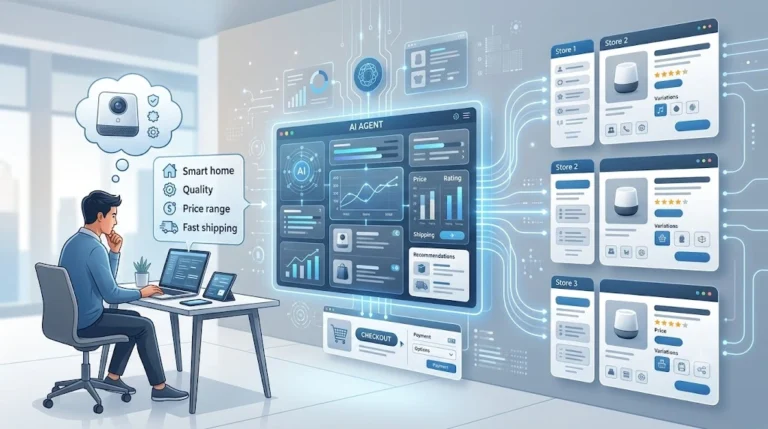
| Agentic Commerce | Executes shopping tasks — comparing, ordering, sometimes paying — within limits the shopper sets |
Most current activity sits in discovery and comparison. Per AI Shopping Agents and Agentic Commerce 2026: Adoption Trends and Execution Limits (ResearchAndMarkets.com, published August 17, 2026, covering global consumer AI usage across the shopping journey), AI usage runs at roughly 62% for product comparison but only about 23% at checkout and 19% post-purchase. Note this measures how often AI tools are used at each stage — it doesn’t isolate how many of those checkout-stage interactions involve an agent actually completing the purchase versus a shopper using AI for a checkout-related question. Read narrowly, it still shows AI usage falls off sharply after the research phase, which is the more defensible takeaway.
12 Ecommerce Trends That Will Shape Online Retail in 2027

1. Agentic Commerce Is Gaining Ground, Carefully
What’s changing: AI agents can now research, compare, and in limited cases complete purchases on a shopper’s behalf, guided by rules the customer sets.
- Relevant for: Retailers with clear, structured product data and predictable pricing/shipping terms.
- Do this now: Make sure your delivery windows, return terms, and pricing are consistent and machine-readable — AI-powered customer support tools are often the first place this shows up operationally.
- Limitation: Trust is the real bottleneck. In Checkout.com’s Agentic Commerce 2026: The State of Consumer Demand and Merchant Readiness report (published June 9, 2026), 27% of consumers surveyed said they trust no organization to operate an AI shopping agent, and 24% said they’ll never delegate a purchase to one.
2. AI Is Becoming a New Product Discovery Channel
What’s changing: AI Overviews, chat-based search, and shopping assistants are surfacing products before shoppers reach a retailer’s site or a traditional search results page.
- Relevant for: Any brand relying on organic search traffic, especially in comparison-heavy categories (electronics, appliances, apparel).
- Do this now: Audit product titles, specs, and descriptions for clarity an AI system can parse — not just keywords a human would type.
- Limitation: Attribution is messy right now. It’s hard to know which AI-driven visits actually convert versus which ones simply research and buy elsewhere.
3. Conversational Commerce Is Expanding Alongside Traditional Search
What’s changing: Chat-based shopping guides are answering product questions, narrowing options, and handing shoppers toward checkout in a single conversation instead of a multi-page browse.
- Relevant for: Categories with high consideration or frequent questions — beauty, electronics, home goods.
- Do this now: Identify your top 20 pre-purchase questions and make sure that content exists somewhere a conversational AI tool can pull from, including via conversational AI for ecommerce support layers.
- Limitation: This complements search-based shopping more than it replaces it — most shoppers still comparison-shop across multiple channels before committing.
4. Checkout Friction Keeps Shrinking
What’s changing: One-click checkout, saved wallets, autofill, and buy-now-pay-later options are becoming standard rather than a differentiator.
- Relevant for: Every ecommerce business, but especially mobile-heavy storefronts where form-filling is the biggest drop-off point.
- Do this now: Run a checkout friction audit — payment method mix, guest checkout, and mobile form behavior are usually the fastest wins.
- Limitation: Removing friction doesn’t fix a weak product-market fit; it just stops losing sales you were already going to make.
5. AI Personalization Is Moving Past Product Recommendations
What’s changing: Personalization is extending into homepage layout, pricing and promotions, email timing, and predictive replenishment — not just “you might also like.”
- Relevant for: Brands with repeat-purchase products (consumables, apparel, subscriptions) and enough first-party data to work with.
- Do this now: Start with post-purchase behavior — reorder timing and retention triggers are the easiest place to apply this, as covered in D2C customer retention strategies built around purchase-behavior signals.
- Limitation: Over-personalization without enough data can backfire into inaccurate or repetitive recommendations that erode trust instead of building it.
6. Composable Commerce Is an Option, Not a Default
What’s changing: Some retailers are moving from all-in-one platforms toward modular, API-first (MACH) architecture to plug in new tools without rebuilding the entire stack.
- Relevant for: Mid-size to enterprise retailers with dedicated technical resources and specific integration needs a standard platform can’t meet.
- Do this now: Before switching anything, map out which specific limitations your current platform actually causes — composable ecommerce architecture only pays off when it solves a real, named problem.
- Limitation: For small and lean teams, composable setups can add cost, complexity, and maintenance overhead that outweighs the flexibility gained. This is not a universal recommendation.
7. AI-Native Operations Are Automating the Back End
What’s changing: Inventory forecasting, dynamic pricing, fraud detection, and returns processing are shifting toward AI-assisted or fully automated systems.
- Relevant for: Multi-location or multi-channel retailers managing inventory across several sales points.
- Do this now: Start with the highest-cost manual process — usually inventory reconciliation or returns triage — before automating everything at once. Ecommerce inventory synchronization tools are a common entry point.
- Limitation: Automation is only as good as the underlying data; messy inventory records will produce confidently wrong forecasts.
8. Social Commerce and Live Shopping Keep Growing — Unevenly
What’s changing: Short-form video is one of the leading social commerce formats today, and livestream shopping specifically is growing off a small US base, per Statista’s U.S. live e-commerce sales tracking. Statista’s own growth figures for this dataset sit behind a paywall, so specific dollar and percentage figures aren’t reproduced here.
- Relevant for: Visually driven categories (fashion, beauty, home) and younger, mobile-first audiences.
- Do this now: Test short-form product video before investing heavily in full livestream production — it’s the lower-cost entry point with the clearer track record.
- Limitation: This is a livestream-specific channel, not all of social commerce — the two aren’t interchangeable when reading adoption data. Livestream purchase penetration in the US remains a small share of shoppers, well below adoption levels in social commerce overall, so treat it as an early, growing channel rather than a mainstream one in Western markets.
9. Mobile Commerce Keeps Getting Less Forgiving
What’s changing: Fast-loading pages, one-tap payments, and integrated app-and-web experiences are becoming the baseline expectation rather than a competitive edge.
- Relevant for: Any business where mobile traffic makes up a meaningful share of visits — for most retailers, that’s now the majority.
- Do this now: Test your actual mobile checkout optimization on real devices, not just a desktop browser resized smaller — payment modal behavior often breaks differently on mobile.
- Limitation: Mobile-first design doesn’t fix a fundamentally confusing product page; it just makes the confusion load faster.
10. AR and Immersive Tools May Improve Purchase Confidence
What’s changing: Virtual try-on and 3D product visualization are helping shoppers evaluate fit and appearance before buying. In a 2022 Snap, Publicis Media, and Alter Agents study of 4,028 shoppers across the US, UK, France, and Saudi Arabia, 80% said they felt more confident buying with AR, and 66% said they believed they’d be less likely to return the item — self-reported intent from a survey, not a measured drop in actual return rates.
- Relevant for: Categories with high size/fit or color-match return rates — apparel, footwear, beauty, eyewear.
- Do this now: Pilot AR on your highest-return product category first, and track your own before/after return data rather than assuming survey intent will match outcomes.
- Limitation: Adoption is still selective — implementation cost and content production (3D assets, AR-ready imagery) are real barriers for smaller catalogs, and independently measured return-rate impact (versus stated intent) is thinner than the confidence data suggests.
11. Fast, Predictable Fulfillment and Easier Returns Are Becoming Baseline
What’s changing: Delivery speed alone is losing its edge; predictability, flexible options, and transparent return policies are increasingly what customers compare between retailers.
- Relevant for: Any retailer competing against marketplaces with strong logistics networks.
- Do this now: Audit your delivery-date accuracy before promising faster shipping — a reliable estimate often matters more to conversion than shaving a day off transit time.
- Limitation: Faster fulfillment usually means higher logistics cost; it needs to be modeled against margin, not adopted reflexively.
12. Sustainability Influences Some Purchases — Price Still Wins More Often
What’s changing: A meaningful share of shoppers say sustainability affects their decisions, and some report willingness to pay a premium for it. PwC’s Voice of the Consumer Survey 2024 (20,662 consumers across 31 countries and territories, surveyed January–February 2024) covers this behavior as part of its broader consumer trust research. More recent research complicates the picture: a 2026 ICERTIAS Business Intelligence Unit analysis of Euromonitor consumer survey data (June and October 2025) concludes that heading into 2026, value and price hold steady while willingness to pay a sustainability premium is weakening.
- Relevant for: Categories where sustainability claims are easy to verify (packaging, sourcing, materials) rather than vague messaging.
- Do this now: Lead with specific, verifiable claims (certifications, sourcing details) instead of broad “eco-friendly” language, which increasingly gets ignored or distrusted.
- Limitation: Don’t build a pricing strategy around a sustainability premium alone — for most categories, it’s a secondary factor, not a primary purchase driver.
How Consumer Behavior May Change by 2027
Shoppers are likely to lean more on AI tools to research and compare products, expect more individualized offers and content, and weigh delivery flexibility alongside speed rather than speed alone. Value-consciousness is holding steady or increasing for most categories, even as some shoppers remain willing to pay more for sustainability or convenience in specific cases. None of this suggests one uniform shift — behavior differs sharply by category, income level, and generation, which is why blanket claims like “customers will expect X by 2027” deserve some skepticism. The more reliable pattern is that whatever reduces friction and builds trust — clear information, fast resolution, predictable delivery — keeps winning, regardless of which specific technology delivers it.
How Ecommerce Businesses Should Prepare for 2027
Start with product data quality — clean, accurate, and structured enough for both search engines and AI tools to read correctly. From there, prioritize based on your actual bottlenecks rather than adopting every trend at once: reduce checkout friction if you’re losing carts, automate the operational process that costs you the most manual hours, and invest in first-party customer data as third-party tracking continues to fade. A more flexible ecommerce technology stack can help larger or fast-growing businesses adapt to new AI tools — but for small and mid-size retailers with limited technical resources, a simpler, well-optimized platform is often the more realistic choice. Preparation should follow your specific constraints — budget, team size, and category — not a generic checklist.
Which Ecommerce Trends Matter Most in 2027?

These ratings are an editorial assessment based on current adoption data and research cited throughout this article, not a formal scoring methodology.
| Trend | Expected Impact | Recommended Priority |
|---|---|---|
| Invisible/Frictionless Checkout | High | High priority — proven, low-risk fix |
| Mobile Commerce | High | High priority — proven, low-risk fix |
| AI Product Discovery | Very High | High priority — audit product data now |
| Fast Fulfillment & Frictionless Returns | High | High priority |
| AI-Native Operations | High | High priority for multi-location/multi-channel sellers |
| AI Personalization | Very High | Prioritize once sufficient first-party customer data exists |
| Conversational Commerce | High | Medium — pilot in high-consideration categories |
| Social Commerce | High | Medium — start with short-form video, not livestream |
| Agentic Commerce | Very High (long-term) | Monitor and run selective pilots — trust barriers remain |
| Composable Commerce | Medium–High | Conditional — only for teams with technical resources |
| Immersive Commerce (AR) | Medium–High | Medium — pilot on highest-return categories |
| Sustainable Ecommerce | Medium | Medium — verifiable claims only, not a pricing strategy |
2027 Outlook and Current Limitations
| Trend | 2027 Outlook | Current Limitation |
|---|---|---|
| AI shopping agents | Growing steadily | Trust and checkout-stage adoption remain low |
| AI product discovery | Mainstream | Attribution and ROI tracking still immature |
| AI personalization | Mainstream | Requires enough first-party data to work well |
| Conversational commerce | Expanding | Complements rather than replaces search |
| Invisible checkout | Growing fast | Doesn’t fix weak product-market fit |
| Composable commerce | Enterprise-focused | Adds complexity for small/lean teams |
| AI-native operations | Mainstream adoption | Only as reliable as underlying data quality |
| Social Commerce (incl. livestream) | Growing, unevenly by format and region | Livestream specifically remains a small share of US purchases so far |
| AR/immersive commerce | Selective adoption | Content production cost is a real barrier |
| Sustainability | Growing interest, mixed behavior | Price and quality still dominate most decisions |
For deeper, continuously updated benchmarks on these categories, retailers can track ongoing consumer and technology research from Statista’s ecommerce research hub — useful for validating any of the above before making a stack or budget decision.
Frequently Asked Questions About Ecommerce Trends in 2027
What will be the biggest ecommerce trend in 2027? AI-led product discovery is one of the key trends to watch, since it’s already changing how customers find products before reaching a retailer’s site — agentic commerce (AI completing purchases) is the bigger long-term story but is still early-stage.
How will AI change ecommerce in 2027? AI is expected to influence discovery, personalization, pricing, inventory, and customer support — but adoption is uneven, and checkout-stage AI usage remains far behind AI-assisted research and comparison.
What is agentic commerce in ecommerce? Agentic commerce refers to AI agents that research, compare, and in some cases complete purchases on a customer’s behalf, operating within limits the shopper sets — current adoption is concentrated in research and comparison, not full autonomous checkout.
Will AI replace traditional ecommerce search? Unlikely to fully replace it by 2027 — conversational and AI-driven discovery are expanding alongside traditional search rather than eliminating it.
What will online shopping look like in 2027? Likely more AI-assisted for research and comparison, with faster checkout and more individualized offers — though adoption will vary significantly by category and region.
Will social commerce continue to grow in 2027? Yes, though growth is uneven by format and region. Livestream shopping specifically is still early in the US, remaining a small share of overall purchases according to Statista’s tracking of the category, while short-form video is already one of the leading social commerce formats overall.
What ecommerce technology should businesses invest in before 2027? Clean, structured product data and reduced checkout friction offer the most reliable return across business sizes; composable architecture is worth considering only for businesses with the technical resources and integration needs to justify it.
How can small ecommerce businesses prepare for 2027? Start with product data quality and checkout friction — both are low-cost, high-impact fixes that don’t require a platform migration or new technology investment.
Final Takeaway

The shift toward AI-assisted discovery, faster checkout, and more individualized shopping is already underway — but not every trend here will move at the same speed, and not every business needs to chase all twelve at once. The more useful question isn’t “which trends are coming” but “which of these actually match my category, budget, and customer base.” Retailers that prioritize based on real bottlenecks — messy product data, slow checkout, manual operations — will likely be better positioned than those adopting new technology for its own sake.
Start with an honest audit, not a trend checklist. Look at your product data, checkout flow, and highest-cost manual processes first — those fixes tend to matter more heading into 2027 than any single new technology.