
Best AI Tools for Ecommerce Customer Support Automation (2026 Guide)
Last updated: August 2026. Pricing and features were checked against vendor pricing pages and independent pricing breakdowns in August 2026 — SaaS pricing changes often, so confirm current rates before you buy.
Running an online store means answering the same questions on repeat — “where’s my order,” “can I return this,” “does this come in my size.” The best AI tools for ecommerce customer support automation now handle most of that volume automatically, so your team only steps in when a conversation actually needs a human. This guide breaks down what these tools automate, which ones are genuinely worth using, how much they cost, and how we scored them — not just a list of ten names with a checkmark next to Shopify.

Quick Comparison: Best AI Ecommerce Customer Support Tools
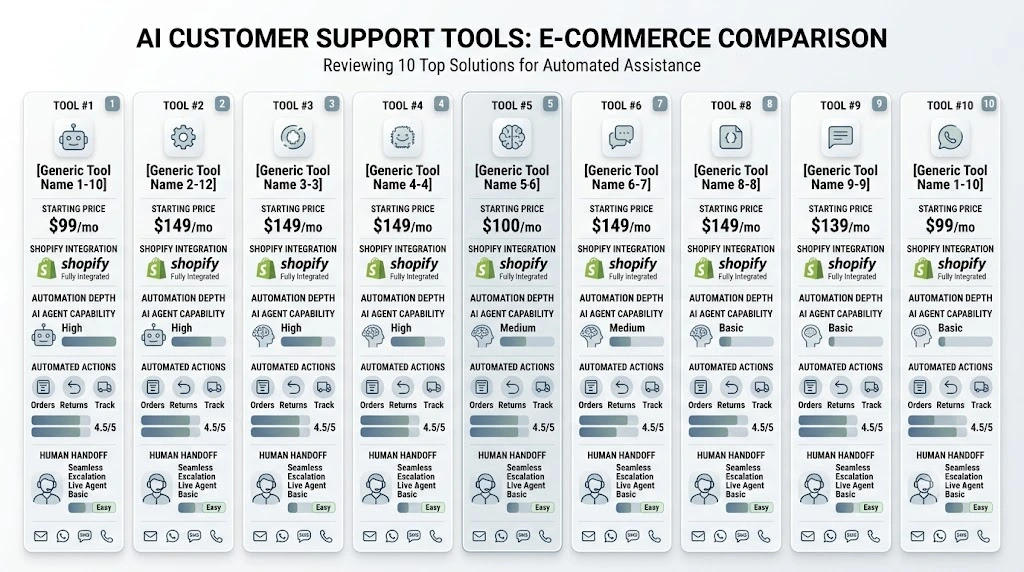
This table separates what each tool can see from what it can do — a Shopify integration that only looks up an order is a different product from one that can also refund it.
| AI Tool | Best For | Starting Price | Shopify Integration | Automated Action | Human Approval Required |
|---|---|---|---|---|---|
| Gorgias | Shopify support automation | $10/mo Starter; AI Agent $0.90/interaction annually or $1 monthly + applicable helpdesk ticket costs | Native | Yes — orders, refunds | Configurable |
| Intercom Fin | AI-first support | $29/seat/mo annually (Essential; $19/seat promotional rate currently shown) + $0.99 per Fin outcome | Via app/integration | Yes, with setup | Configurable |
| Zendesk AI | Enterprise support | $55/agent/mo (AI included) | Via connector | Yes on Advanced tier | Configurable |
| Freshworks Freddy | Full support suite | $19/agent/mo (Growth); includes 500 Freddy AI Agent sessions, then $49/100 sessions; Pro at $55/agent/mo for broader features | Via connector | Yes on Growth and above | Configurable |
| Tidio Lyro | Small stores | Free plan; Lyro AI add-on from $39/mo | Native | Limited — mostly lookup/FAQ | Yes, usually |
| Yuma AI | DTC brands | $14,400/yr ( | Via helpdesk | Yes — orders, refunds, cancellations | Configurable |
| Siena AI | Ecommerce automation | ~$750/mo + $0.90/automated ticket | Native (Shopify, Fulfil) | Yes — refunds, address edits | Configurable |
| Ada | Enterprise automation | Quote-based; scales with conversation volume and requirements | Via connector | Yes, deep workflows | Configurable |
| Re:amaze | Small ecommerce teams | $29/agent/mo (or $59/mo flat, unlimited seats, 500-conversation cap) | Native | Yes, within plan allowance (5/10/20 resolutions per user/mo by tier; $0.85 per extra) | Yes, usually |
| Richpanel | DTC customer service | $29/agent/mo (AI-inclusive tiers from ~$69/agent/mo) | Native | Yes on AI-inclusive tiers | Configurable |
A checkmark for “Shopify integration” only means the tool can read your order data — not that it can independently refund a customer or change an address. That distinction is exactly what the next sections dig into.
What Can AI Automate in Ecommerce Customer Support?
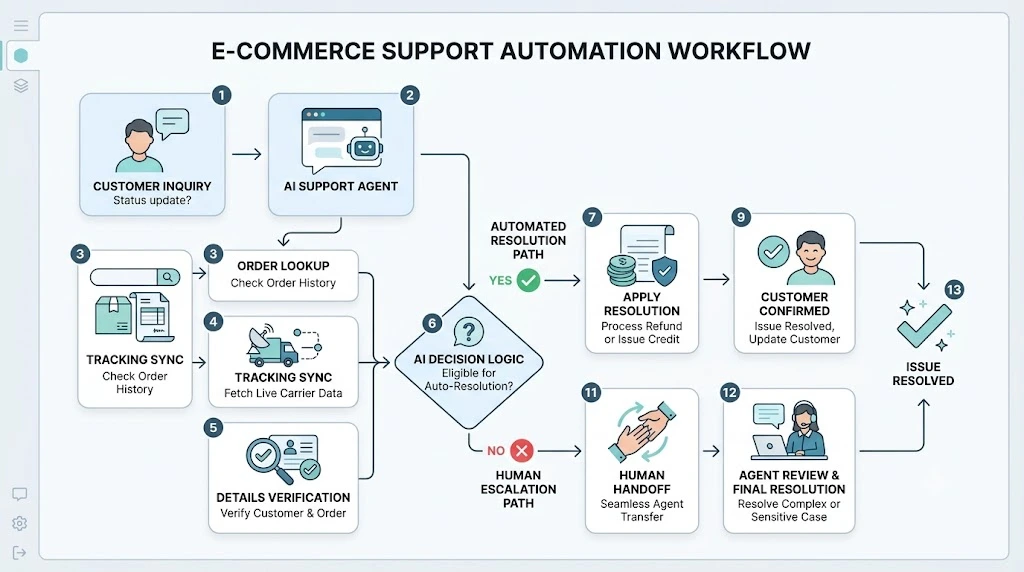
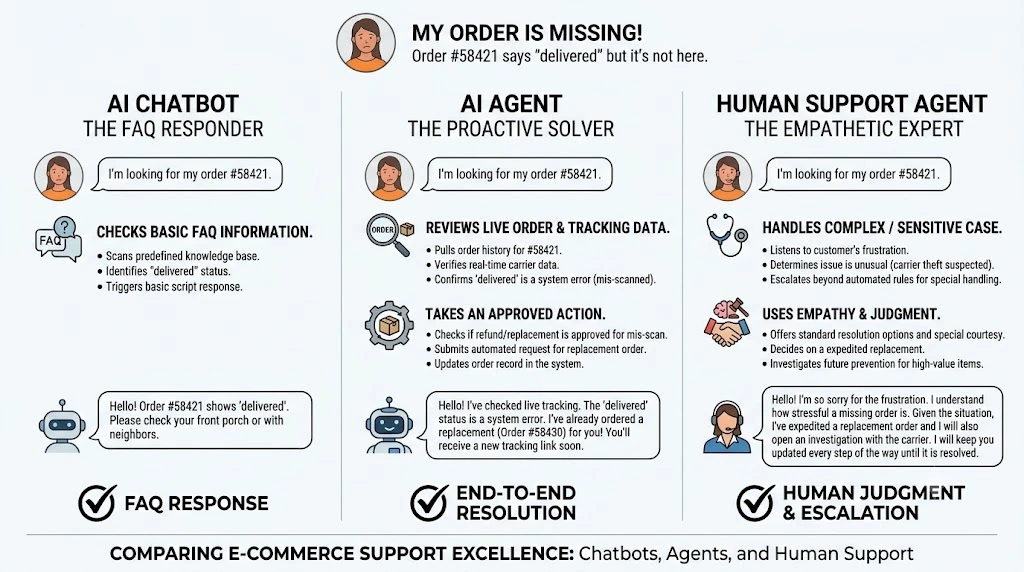
Not every AI tool automates the same things. Some only answer FAQs; others take real action inside your store. Here’s a concrete example before we break it down: a customer messages “my package says delivered but I never got it.” A capable AI agent checks the carrier’s tracking status, confirms the delivery address on file, asks the two or three verification questions your policy requires, and either issues a resolution on the spot or escalates to a human with all of that context already attached — instead of making the customer repeat themselves.
Order Status and Tracking
Customers ask where their order is more than anything else. Good AI tools pull live tracking data and answer instantly instead of routing to an agent.
Returns and Refunds
From checking return eligibility to processing a refund, this is where automation saves the most agent hours — provided the tool connects directly to your order system rather than just your help center articles.
Product Questions
Sizing, availability, specifications, and compatibility questions get handled through a connected product catalog rather than generic scripted replies.
Order Changes and Cancellations
Address updates, cancellations, and subscription changes require the AI to actually modify order data, not just acknowledge the request.
FAQs and Policy Questions
Shipping, returns, payment, and warranty policies are the easiest wins — but they still need to stay accurate as policies change.
Human Agent Escalation
The strongest automation doesn’t try to answer everything. Complex or high-risk cases should hand off to a human agent along with full conversation context, not a blank slate.
10 Best AI Tools for Ecommerce Customer Support Automation
Each tool below is scored against the weighted methodology in the next section. Scores reflect our own editorial assessment based on published features and pricing, not a guarantee of results for your store.
1. Gorgias — Best for Shopify Customer Support Automation
Editorial score: 9.2/10 · Starting price: $10/mo Starter (50 tickets); the practical entry tier is Basic at $60/mo (300 tickets); AI Agent is billed separately from the helpdesk plan at $0.90 per interaction on annual billing or $1 on monthly, so heavy AI usage can materially increase your monthly cost · Shopify: Native · AI agent: Yes · Order tracking: Yes · Returns/refunds: Yes · Channels: Chat, email, social, SMS/voice add-on
Gorgias is built specifically around Shopify, pulling order and customer data directly into the conversation so the AI Agent can act — issuing refunds, updating orders, and answering WISMO questions — not just suggest a reply. Pricing is ticket-based rather than a flat per-seat fee, but AI Agent usage bills on top of your ticket plan, so heavy automation usage raises the real monthly cost well above the $10 or $60 sticker price.
Pros: Deep native Shopify order actions; strong ecommerce focus; multi-channel support.
Cons: AI Agent billing stacks on top of ticket fees, which can surprise teams at scale; overage pricing on both tickets and resolutions.
Best for: Shopify-first brands that want order actions handled automatically, not just answered.
Not ideal for: Stores on WooCommerce or BigCommerce as their primary platform.
Verdict: The strongest Shopify-native pick on this list, provided you model AI resolution costs into your budget before signing. For a Shopify-only shortlist, see our best AI customer support tools for Shopify guide.
2. Intercom Fin — Best for AI-Powered Customer Support
Editorial score: 9.0/10 · Starting price: Essential seat plans from $29/seat/mo on annual billing (a $19/seat promotional rate is currently shown for new customers) plus $0.99 per Fin outcome; a standalone Fin deployment runs $49/mo base + $0.99/outcome · Shopify: Via app/integration, not native · AI agent: Yes · Order tracking: With setup · Returns/refunds: With setup · Channels: Chat, email
Fin is Intercom’s AI agent, trained on your help content and connected data to resolve conversations end-to-end before handing off to a human. Pricing is outcome-based — you pay per resolution, procedure handoff, or disqualification — which rewards a well-organized knowledge base and can get expensive to forecast at high volume. It’s less ecommerce-native out of the box than Gorgias or Yuma, so order actions depend on how you wire it into your store.
Pros: Genuinely conversational AI; transparent published per-resolution rate; strong for brands already on Intercom.
Cons: Not Shopify-first — ecommerce order actions require additional setup; seat-plus-outcome pricing has two layers to budget for.
Best for: Teams that want a best-in-class conversational AI agent and are comfortable configuring ecommerce actions themselves.
Not ideal for: Small stores wanting a Shopify plug-and-play setup with no configuration.
Verdict: A strong, transparent-pricing choice for AI-first support, with the caveat that ecommerce-specific actions take more setup than category-native tools.
3. Zendesk AI — Best for Enterprise Ecommerce Support
Editorial score: 8.8/10 · Starting price: Suite Team at $55/agent/mo (annual billing) includes baseline AI agents; Advanced AI agent resolutions run roughly $1.50–$2 each; Copilot adds $50/agent/mo · Shopify: Via connector · AI agent: Yes · Order tracking: Yes, with integration · Returns/refunds: Yes, with integration · Channels: Omnichannel
Zendesk positions its AI agents around guided selling alongside automated workflows like order status, returns, and refunds, layered onto its long-standing omnichannel helpdesk. It suits larger teams needing detailed reporting and enterprise integrations, but the total bill — seats, Copilot, and per-resolution AI fees — climbs quickly once you add automation at scale.
Pros: Mature omnichannel platform; detailed reporting; broad integration ecosystem.
Cons: Multi-layered pricing (seats + add-ons + per-resolution AI) makes budgeting harder than single-line pricing models; overkill for small stores.
Best for: Larger ecommerce or multi-brand operations needing enterprise-grade infrastructure.
Not ideal for: Single-channel or small-volume stores — the AI layer alone can cost more than a smaller store’s entire support budget.
Verdict: A capable enterprise platform, but confirm your real per-resolution volume before assuming the $55 headline price is your bill.
4. Freshworks Freddy AI — Best Full-Service Support Platform
Editorial score: 8.3/10 · Starting price: Freshdesk Growth at $19/agent/mo, which includes a one-time complimentary allocation of 500 Freddy AI Agent sessions; additional sessions cost $49 per 100; Freddy AI Copilot (agent-assist, separate from the customer-facing AI Agent) is restricted to Pro ($55/agent/mo) and Enterprise · Shopify: Via connector · AI agent: Yes, from Growth · Order tracking: With integration · Returns/refunds: With integration · Channels: Omnichannel (full channel coverage on Freshdesk Omni, a separate pricing ladder)
Freddy AI sits inside Freshworks’ broader helpdesk, combining ticket automation with a knowledge base and routing. Freshdesk Growth at $19/agent/mo includes 500 free Freddy AI Agent sessions per Freshworks’ own documentation, so the customer-facing AI is usable from the entry tier — but the 500 sessions are a one-time allocation, not monthly, and Freddy AI Copilot (the agent-assist layer) only unlocks on Pro or Enterprise. Live chat and full omnichannel routing also sit on the separately priced Freshdesk Omni line.
Pros: Freddy AI Agent is usable from the entry Growth tier, not gated to Pro; session-based pricing is predictable at moderate volume; strong knowledge base tools.
Cons: The 500 included sessions are a one-time allocation, not a monthly renewal; Copilot and full omnichannel each require a tier or product jump.
Best for: Teams that want a complete support suite with AI layered in, not just a standalone chatbot.
Not ideal for: Budget-conscious small stores wanting AI on the cheapest plan.
Verdict: A strong middle-ground option if you want AI inside a full helpdesk; Growth can be enough for basic AI-agent use, while Pro adds more advanced routing, reporting, and agent-assist capabilities.
5. Tidio Lyro — Best for Small Ecommerce Businesses
Editorial score: 7.6/10 · Starting price: Free plan available (50 lifetime AI conversations); paid plans from $29/mo (Starter); Lyro AI add-on billed separately from $39/mo · Shopify: Native · AI agent: Yes, as a metered add-on · Order tracking: Limited · Returns/refunds: Limited · Channels: Chat, email
Lyro is built for affordability and quick setup, answering FAQs and basic order questions on Shopify or WooCommerce stores. Lyro AI is metered separately from the base support plan; independent cost breakdowns commonly put the real-world total (base plan plus Lyro) in the $100–150/month range for stores with moderate AI conversation volume, though your exact number depends on your conversation mix.
Pros: Fast setup; genuinely free tier to test on; native Shopify and WooCommerce support.
Cons: AI conversations are billed and capped separately from the base plan; order-action depth is limited compared to Gorgias or Yuma.
Best for: Small stores starting their automation journey with a tight budget.
Not ideal for: Stores expecting the AI to independently process refunds or complex order changes.
Verdict: A reasonable low-cost entry point — just budget the Lyro add-on into your real monthly cost from day one.
6. Yuma AI — Best for High-Volume DTC Brands
Editorial score: 8.9/10 · Starting price: $14,400/year ($1,200/mo) for 12,000 resolutions ($1.20/resolution); higher-volume plans are available · Shopify: Via your existing helpdesk (Gorgias, Zendesk, Kustomer, Front, Re:amaze) · AI agent: Yes · Order tracking: Yes · Returns/refunds: Yes, including exchanges and address changes · Channels: Email, chat, WhatsApp, social, SMS (no voice)
Yuma focuses on ecommerce-specific automation — order tracking, refunds, cancellations, exchanges, and address changes — layered onto the helpdesk you already run rather than replacing it. Pricing starts at $14,400/year for 12,000 resolutions; higher volumes require a sales conversation, but the outcome-based structure means you aren’t charged for tickets it escalates.
Pros: Deep ecommerce-specific action set; only pay for fully resolved tickets; plugs into an existing helpdesk instead of forcing a migration.
Cons: Published pricing only covers the entry tier — higher-volume plans require a sales call; no phone/voice channel.
Best for: High-volume DTC brands that already run a helpdesk and want deeper automation layered on top.
Not ideal for: Brands needing phone support as a core channel.
Verdict: One of the strongest picks here for actual automated action-taking, if you’re comfortable with opaque, quote-based pricing.
7. Siena AI — Best for Ecommerce Brand Experience
Editorial score: 8.6/10 · Starting price: Reported around $750/mo platform fee plus roughly $0.90 per automated ticket, finalized on a sales call · Shopify: Native (Shopify and Fulfil) · AI agent: Yes · Order tracking: Yes · Returns/refunds: Yes, including address edits and subscription changes · Channels: Email, chat, WhatsApp, SMS, social
Siena leans into personalized, on-brand conversational AI, with a persona system tuned to your tone rather than a generic script. It handles the core DTC workload — tracking, returns, refunds, subscription changes — and integrates with subscription platforms like Recharge and Skio. The pricing floor makes it a harder sell for very small stores; the per-ticket fee scales with volume regardless of order value, so the math favors brands with healthy margins per ticket.
Pros: Strong brand-voice customization; deep subscription-commerce integrations; agentic actions, not just replies.
Cons: High pricing floor ($750/mo before any tickets); Shopify/Fulfil only, no WooCommerce.
Best for: Established DTC brands where brand voice consistency is a real priority.
Not ideal for: Very small stores with low support volume or limited margins, or anyone on WooCommerce.
Verdict: A premium, brand-focused option that earns its price at meaningful ticket volume — less so below it.
8. Ada — Best for Enterprise Customer Support Automation
Editorial score: 8.7/10 · Starting price: Quote-based; enterprise pricing depends on conversation volume, channels, integrations, and deployment requirements · Shopify: Via connector · AI agent: Yes · Order tracking: Yes, with integration · Returns/refunds: Yes, with integration · Channels: Omnichannel, including voice
Ada is designed for enterprise-scale support operations, with genuine omnichannel coverage including voice and extensive governance and compliance capabilities. That scale and control come at an enterprise price and a sales-led, quote-only process with no self-serve trial.
Pros: True omnichannel including voice; strong compliance and governance tooling; deep integration list.
Cons: No transparent self-serve pricing; not cost-effective below enterprise conversation volumes.
Best for: Large ecommerce or retail operations with high conversation volume and compliance requirements.
Not ideal for: Small to mid-size stores — the pricing floor alone rules most of them out.
Verdict: A capable enterprise platform reserved for brands operating at genuine scale.
9. Re:amaze — Best Budget-Friendly Ecommerce Helpdesk
Editorial score: 7.2/10 · Starting price: $29/agent/mo (Basic), or a flat $59/mo Starter plan with unlimited seats and a 500-conversation monthly cap · Shopify: Native (also BigCommerce, WooCommerce) · AI agent: Included, with a plan-specific monthly allowance — 5 resolutions per user on Basic, 10 on Pro, 20 on Plus, per Re:amaze’s own pricing page — plus $0.85 per additional resolution · Order tracking: Yes, via Shopify order data in-conversation · Returns/refunds: Supported through Shopify staff-side actions (refund, cancel, draft orders), typically agent-initiated · Channels: Chat, email, social; SMS/voice via third-party add-ons
Re:amaze combines live chat, email, and social support with chatbot-style automation at an accessible price, and its flat-rate Starter plan is a rare offer for very small teams. Its AI Agent is still labeled Beta on Re:amaze’s own site, with resolution allowances that are modest per seat, so its AI automation is less action-oriented than tools such as Gorgias or Yuma.
Pros: Genuinely affordable, especially the flat-rate Starter plan; solid native Shopify order visibility for agents.
Cons: Per-seat AI resolution allowances are modest before overage charges apply; AI Agent remains in Beta; SMS and voice depend on third-party add-ons.
Best for: Small ecommerce teams under 10 agents wanting an affordable, Shopify-aware helpdesk.
Not ideal for: Brands wanting AI to independently process refunds or complex order changes at volume.
Verdict: A solid budget helpdesk with light AI — not a substitute for a dedicated automation-first tool if deep action-taking is the goal.
10. Richpanel — Best for DTC Customer Service Automation
Editorial score: 8.0/10 · Starting price: $29/user/mo entry tier (no AI); AI-inclusive plans start around $69/agent/mo, with pricing varying by plan and billing term, plus a separate order-volume-based fee for the self-service portal · Shopify: Native · AI agent: Yes, on AI-inclusive tiers · Order tracking: Yes · Returns/refunds: Yes, on AI-inclusive tiers · Channels: Omnichannel; WhatsApp requires the Pro tier
Richpanel emphasizes self-service alongside AI support, letting customers resolve returns and order questions without waiting on an agent. AI Employees and the self-service customer portal — the features that differentiate it from a standard helpdesk — sit above the $29 entry tier, so budget for the AI-inclusive plan rather than the advertised starting price if automation is the point.
Pros: Self-service portal reduces ticket volume directly; AI-inclusive tier bundles automation without a separate per-resolution meter.
Cons: The headline $29 price excludes AI and the self-service portal, the tool’s core differentiators; portal fees scale with order volume as a separate line item.
Best for: DTC brands wanting customers to self-serve returns and order changes.
Not ideal for: Teams assuming the entry-tier price includes AI — it doesn’t.
Verdict: A strong self-service-first pick once you price the AI-inclusive tier, not the entry one.
How We Compared These AI Customer Support Tools
Every tool above is scored using FutureCommerce’s 40-point evaluation framework — Features & Capabilities, Performance & Reliability, Ease of Use, Integrations & Ecosystem, Scalability & Flexibility, Pricing & Value, Security & Data, and Real-World Commerce Fit — applied consistently across every tool we review. For this category specifically, we paid closest attention to:
AI Resolution Capability — Does the AI actually resolve the issue, or just suggest an answer for an agent to send?
Ecommerce Integrations — Native support for Shopify, WooCommerce, BigCommerce, and similar platforms, versus a bolt-on connector.
Order Data Access vs. Automated Action — Seeing order data and acting on it (refunding, cancelling, editing) are different capabilities; we scored them separately rather than treating a Shopify checkmark as proof of automation.
Returns/Refunds Capability — Whether the AI can process a refund end-to-end or just flag eligibility for a human to action.
Channel Coverage — Chat, email, SMS, social, and voice coverage.
Human Handoff Quality — How smoothly complex issues transfer to a human agent, along with context.
Pricing Transparency — Whether the published starting price includes AI, or whether AI is a separate metered add-on — a distinction that changed several rankings above.
This is applied using each vendor’s published pricing and feature documentation — it isn’t a substitute for testing a tool against your own ticket volume before you commit.
AI Ecommerce Customer Support Tools by Use Case
| If You Need… | Best Choice |
|---|---|
| Shopify support | Gorgias |
| Enterprise support | Zendesk / Ada |
| Small store | Tidio |
| DTC automation | Yuma / Richpanel |
| Omnichannel support | Zendesk / Freshworks |
| AI-first support | Intercom Fin |
| Returns & refunds | Gorgias / Yuma |
| Budget solution | Tidio / Re:amaze |
Matching the tool to your use case matters more than chasing the highest overall score — a feature-rich enterprise platform can be wasted (and expensive) on a five-person team.
How to Choose the Right AI Customer Support Tool for Your Ecommerce Store
For Small Ecommerce Stores
Prioritize low cost, quick setup, native Shopify integration, and reliable FAQ automation before anything more advanced — and check whether AI is included in the entry price or billed as an add-on.
For Growing DTC Brands
Look for order automation, returns and refunds handling, multi-channel coverage, and reporting that shows where automation is actually saving time. Support quality also feeds directly into whether a customer buys again — see our customer retention strategies for small D2C brands guide for the retention side of this equation.
For Enterprise Ecommerce
Security, governance, deep integrations, and advanced routing matter more here than raw chatbot features — scalability and compliance are the deciding factors.
AI Chatbot vs. AI Agent vs. Human Support
The terms “chatbot” and “AI agent” get used interchangeably in marketing, but they behave very differently in practice.
| AI Chatbot | AI Agent | Human | |
|---|---|---|---|
| FAQ | ✅ | ✅ | ✅ |
| Order lookup | Limited | ✅ | ✅ |
| Refund action | Usually no | Sometimes | ✅ |
| Complex cases | ❌ | Escalates | ✅ |
| 24/7 availability | ✅ | ✅ | ❌ |
| Judgment on edge cases | ❌ | Limited | ✅ |
This is the distinction that should actually drive your buying decision: a chatbot deflects simple questions, an AI agent resolves them end-to-end within its guardrails, and a human handles anything genuinely ambiguous. Confusing the three is the single most common mistake in this category.
How Much Does AI Ecommerce Customer Support Cost?
Pricing structure matters as much as the sticker price, and it’s the part vendors are least upfront about.
Per-Agent Pricing charges by seat, regardless of ticket volume (Zendesk, Freshworks, Re:amaze, Richpanel). Per-Resolution or Outcome-Based Pricing charges only for what the AI actually resolves (Intercom Fin, Yuma, Siena, Gorgias’s AI Agent). Usage-Based Session Pricing meters AI conversations separately from the base plan (Tidio Lyro, Freshworks Freddy sessions). Enterprise Custom Pricing is negotiated around scale and support needs (Ada, and Zendesk/Siena at higher volumes).
The cheapest advertised tool isn’t automatically the lowest-cost option. A per-resolution model can look cheap at low volume and expensive at scale, while a per-seat model does the opposite — the same $0.99-per-resolution rate that’s a bargain at 200 tickets a month becomes a five-figure line item at 20,000.
Before You Calculate ROI: Know Your Numbers
Before choosing a tool, calculate the inputs that actually determine what you’ll pay and save:
- Monthly ticket volume — your current total, including seasonal peaks like BFCM
- Realistic AI-resolution percentage — vendors often cite best-case rates; budget for the low end of their stated range
- Human-agent cost per ticket — fully loaded, including time, not just salary divided by ticket count
- Expected AI cost at your volume, using the pricing model above, not the advertised starting price
- Peak-season volume — the month your AI bill (and your savings) will be highest
These five numbers feed directly into the ROI formula below.
How to Calculate AI Customer Support ROI
Keep the cost-savings math separate from any revenue claims — combining them into one number can overstate the case for a tool.
Primary formula — AI Support ROI:
AI Support ROI = (Human Support Cost Saved − AI Cost) ÷ AI Cost × 100
For example, automating 800 tickets a month at $4 average human cost per ticket saves $3,200. If the AI tool costs $500 a month, ROI works out to 540% on support cost savings alone.
Secondary metric — Additional Revenue Impact:
Track any revenue lift (faster responses reducing cart abandonment, upsells surfaced by the AI) as a separate line, not folded into the ROI formula above, since revenue attribution is harder to verify than a straightforward labor-cost offset.
How to Implement AI Customer Support in an Ecommerce Store
- Identify repetitive support queries your team already answers most often.
- Connect product and order data so the AI can pull real information, not guesses.
- Build your knowledge base with clear, current policy content.
- Set automation rules for which queries the AI handles independently.
- Define human escalation rules for sensitive or complex cases.
- Test before going live using real past customer conversations.
- Monitor resolution rate weekly, not just at launch.
- Improve the AI using flagged conversations and agent feedback.
Common Mistakes When Choosing an AI Customer Support Tool
- Choosing based only on the advertised starting price, not the price at your real AI usage volume
- Confusing a simple chatbot with a true AI agent that can take action
- Ignoring ecommerce platform integrations, or assuming an integration means the AI can act, not just look things up
- Automating sensitive issues without a human escalation path
- Skipping tests with real customer questions before launch
- Overlooking how the pricing structure scales with volume, especially around seasonal peaks
Frequently Asked Questions
Which AI tool is best for ecommerce customer support?
It depends on store size and platform. Gorgias scores highest overall for Shopify-first brands because it natively handles order actions and refunds, while Zendesk and Ada fit enterprise-scale support needs with omnichannel coverage and governance. There isn’t a single best tool across every store size — match the pick to your platform and ticket volume.
What is the best AI chatbot for ecommerce?
Tidio Lyro is a strong starting point for small stores on a tight budget, with a genuine free tier to test on. Intercom Fin suits brands wanting a more conversational, higher-resolution AI experience, though it costs more per resolution and takes more setup for ecommerce-specific actions.
Which AI customer support tool is best for Shopify?
Gorgias is built specifically around Shopify order and customer data, with native order actions and refund processing rather than a bolt-on integration. Richpanel and Re:amaze are also Shopify-native, but with lighter automation depth unless you’re on their AI-inclusive tiers. For a Shopify-only shortlist, see our best AI customer support tools for Shopify guide.
Can AI automate ecommerce returns and refunds?
Yes — Gorgias, Yuma, Siena, and Richpanel’s AI-inclusive tiers can check eligibility and process refunds directly when connected to order data. Tools like Tidio and Re:amaze can check eligibility but typically hand the actual refund off to a human agent rather than processing it autonomously.
Can AI agents check order status?
Yes, provided the tool integrates with your ecommerce platform to pull live tracking and order information. This is the most reliably automated capability across nearly every tool on this list, including budget options.
How much does AI customer support cost?
It varies by pricing model — per seat, per conversation, per resolution, or usage-based — and the advertised starting price often excludes AI itself. Realistic monthly costs range from roughly $50–150 for a small store on Tidio or Re:amaze to several thousand dollars a month for DTC brands on Yuma or Siena at real volume, and into five or six figures annually for enterprise platforms like Ada.
Can AI replace ecommerce customer support agents?
Not entirely. AI handles repetitive, low-risk queries — order status, basic returns, FAQs — well, but complex, emotional, or ambiguous issues still need human judgment. The strongest implementations treat AI as a filter that clears volume so agents spend their time on the cases that actually need a person.
What is the best AI customer service tool for small ecommerce businesses?
Tidio offers a free entry point for testing, while Re:amaze offers a flat-rate Starter plan with unlimited team members and a 500-conversation monthly allowance. AI usage and included limits vary, so compare the total cost at your expected volume.
How do I automate customer support for my online store?
Start by identifying repetitive queries, connecting order data, and setting clear automation and escalation rules before going live — the eight-step process outlined earlier in this guide walks through the full sequence. Testing against real past conversations before launch catches most embarrassing failures before customers see them.
Is AI customer support worth it for ecommerce?
For stores handling repetitive tickets at meaningful volume, yes — the ROI formula above makes the savings easy to calculate against your own ticket counts and agent costs. Below a certain volume, though, the pricing floor on some tools (Siena, Ada) can exceed what you’d spend on a part-time human agent, so run the math before committing.
Final Verdict — Which AI Ecommerce Support Tool Should You Choose?
- Choose Gorgias if Shopify plus order automation is your priority — it’s our top overall score for a reason.
- Choose Intercom Fin if AI-first conversations and transparent per-resolution pricing matter most.
- Choose Zendesk if you need enterprise-grade support infrastructure and can absorb the layered pricing.
- Choose Freshworks if you want AI bundled inside a full support suite — Growth covers basic AI-agent use, Pro adds deeper routing and reporting.
- Choose Tidio if you’re a small store needing an easy, low-cost setup and can budget the Lyro add-on separately.
- Choose Yuma if you need high-volume DTC automation layered onto an existing helpdesk.
- Choose Siena if brand-focused conversational experience is the priority and your ticket volume justifies the pricing floor.
- Choose Ada if you need enterprise-scale automation, including voice, and have the budget for it.
- Choose Re:amaze if you want a budget-friendly ecommerce helpdesk and don’t need autonomous refund processing.
- Choose Richpanel if DTC self-service matters most and you’re pricing the AI-inclusive tier, not the entry one.
Start with the tool that matches where your store is today, not where you hope to be in two years — you can always upgrade automation depth as ticket volume grows.