
How Rising Shipping Costs Affect Small E-commerce Profit Margins

Your sales can go up while your profit goes down. Shipping is often the reason.
A carrier raises its rates by a few percent, adds a surcharge, and changes how it measures package size. None of it looks dramatic on a single invoice. But the shipping cost impact on profit adds up fast, because it hits every order you send.
This guide shows you how to measure that hit, which orders suffer most, and what to review first. You will also see a worked example you can copy into a spreadsheet today.
How Rising Shipping Costs Reduce Profit Per Order
Think of each order as a small bucket of profit. Shipping is a hole in the bucket. When the hole gets bigger, less is left at the end.
Small US sellers report feeling this. In its 2026 Merchant Insights Report, ShipStation ran an online survey in Q2 2026 of 868 US retail businesses with fewer than 500 employees. Sixty-two percent said high shipping and freight rates were limiting their growth. ShipStation also notes that UPS and FedEx set 2026 general rate increases near 6%, with surcharges pushing the effective increase higher for most shippers. A general rate increase is an average, so what you pay depends on your package sizes, weights and delivery zones.
This is survey evidence from US merchants, not a global statistic. Use it as context, then check your own invoices.
Why a small shipping increase matters
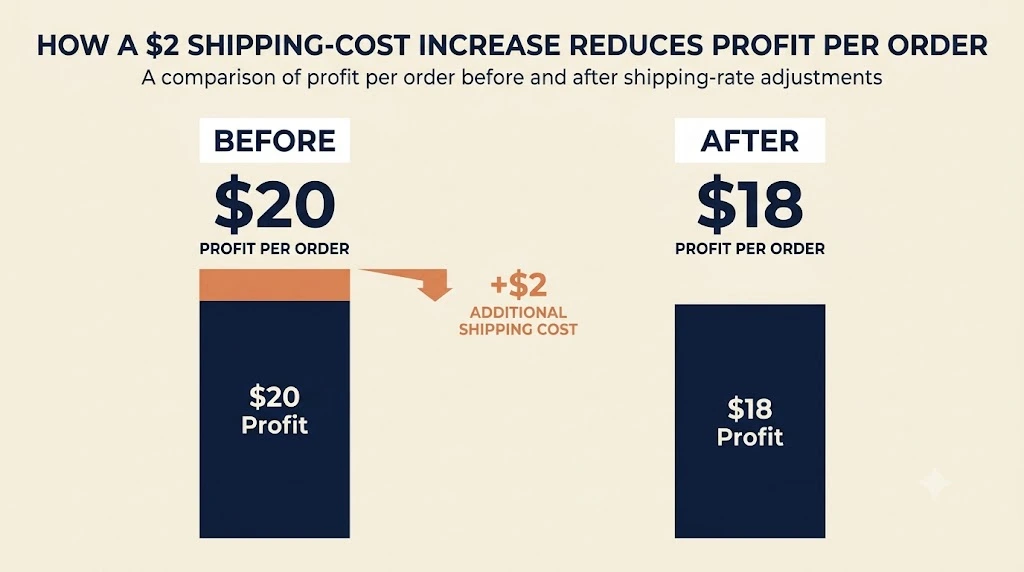
A $2 increase sounds harmless. Now put it next to a profit of $20 on an order.
That $2 is not 2% of your profit. It is 10%. Small increases feel small only when you compare them with the shipping bill. Compare them with what you actually keep, and they look very different.
Customer shipping fees versus actual shipping expense
Many stores charge a flat shipping fee and think the problem is covered. It rarely is.
What the customer pays and what the carrier charges are two separate numbers. Add packaging, label fees and surcharges, and the gap can be wider than you think. If you charge $5 and your real cost is $8, you are already paying $3 per order from your own pocket. An increase in shipping costs makes that gap bigger.
Calculate the Profit Impact of a Shipping Cost Increase.
You do not need special software. The trick is to change only one thing: the shipping cost. Keep the same order, the same revenue and the same other costs, then see what moves.
Here, “profit per order” means what is left after product cost, shipping, payment fees and packaging. It is before advertising, returns, software and overheads, so it is not your total business profit.
Compare profit before and after the increase
This is an illustrative example, not real industry data. Imagine one order with a $45 product. The customer pays a $5 shipping fee, so revenue is $50. Product cost, payment fees and packaging come to $20.75 and stay the same. Only the carrier charge changes, from $8 to $10.
| Line item | Before | After |
|---|---|---|
| Order revenue | $50.00 | $50.00 |
| Other order costs (product, payment fees, packaging) | -$20.75 | -$20.75 |
| Actual shipping cost | -$8.00 | -$10.00 |
| Profit per order (before advertising and overheads) | $21.25 | $19.25 |
| Profit as a share of revenue | 42.5% | 38.5% |
Profit per order falls by $2, or about 9.4%. The profit margin drops from 42.5% to 38.5%, a decline of 4 percentage points. The store did nothing wrong. Only the shipping cost per order changed.
Example: What happens when shipping costs rise by $2 per order?
That table is the $2 case. The useful lesson is the size of the drop. A $2 rise looks small next to a $10 label, but it takes about 9% off what you keep on each order.
Your own numbers will differ. Pull one recent order, swap in your real shipping cost, and run the same before-and-after check.
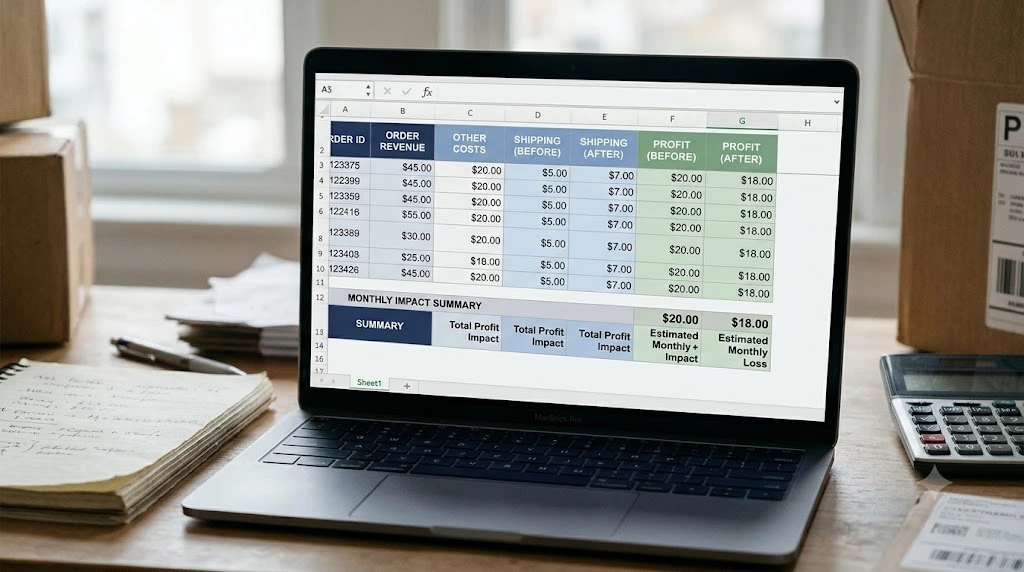
Calculate the monthly impact across order volume.
Now multiply. At 1,000 orders a month, that $2 becomes $2,000 less profit every month, or $24,000 over a year.
This is where the problem becomes visible. One order hides it. A full month shows it clearly.
For a broader explanation of how revenue and variable costs determine profitability, see our guide on how to calculate contribution margin.
Which Orders Are Most Affected by Higher Shipping Costs?
Not every order takes the same hit. Averages hide the orders that hurt most.
Low-value orders
Shipping does not scale with price. A $25 order and a $90 order can cost almost the same to send.
Here is another illustrative case, using the same profit definition. A $25 order with free shipping has $12.03 of other costs (product, payment fees, and packaging). With an $8 label, profit is $4.97. Raise the label to $10, and profit falls to $2.97. That is a 40% drop from the same $2 increase.
Bulky or heavy products
Carriers price by weight and by package size. Larger boxes can trigger dimensional weight charges and handling surcharges. A product that looked profitable last year can quietly slip into thin-margin territory.
Higher-cost delivery zones
Distance matters. So do remote and rural delivery surcharges. If you ship nationwide at one flat price, your nearest customers are helping to pay for your furthest ones.
How to Measure Shipping Cost Impact on Profit
Measure the same three things every month. Do it consistently and surprises stop.
Track shipping cost per order
Pull your carrier invoices, not your estimates. Divide total shipping spend by the number of orders. Do it by product type too, if you can.
Measure shipping costs as a percentage of sales.
Divide shipping cost by sales. This shows whether e-commerce shipping costs are growing faster than revenue and how much they are reducing the margin on each sale.
Outside data helps you sense the direction. Deposco’s Q3 2026 Commerce Signal uses platform data through September 30, 2026. It reports a parcel inflation of 6.9% year over year at the Q3 close. That measures what a fixed mix of packages costs at current carrier rates, compared with the same day a year earlier. That is down from 12.9% at the Q2 close. So the pace of increase has eased, but shipping still costs more than it did a year ago.
Deposco also reports a separate quarter-over-quarter comparison, which sets Q3’s average cost per package against Q2’s. On that measure, carrier rates fell 3.3%, while what operators actually paid fell only 0.6%. Deposco points to heavier packages, faster services and more residential deliveries as the reasons. It also forecasts, with moderate confidence, that the average cost per package in Q4 will come in above Q3’s.
Keep the two measures apart. The 6.9% is year over year. The 3.3% and 0.6% are quarter-over-quarter. Both come from Deposco’s own platform, which covers more than 4,900 operators, so use them as a signal and not as a market-wide benchmark.
Compare actual shipping expenses over time.
Line up the last six months side by side. Look for jumps after surcharge dates or carrier changes. If a month looks off, check for new fees on the invoice before blaming demand. The Deposco finding above is a good reason to look: your average cost per package can stay high even when carrier rates dip if your order mix gets heavier.
What Small Ecommerce Stores Should Review After a Shipping Increase
Do not rebuild your whole store. Once you know which orders lost profit, check three things.
Review prices where profit impact is material.
Start with products that have the thinnest margins and the heaviest packaging. A small price change on those items may recover part of the lost profit.
You do not need to raise every price. Change only the ones where the numbers say you must.
Reassess customer-paid versus store-paid shipping.
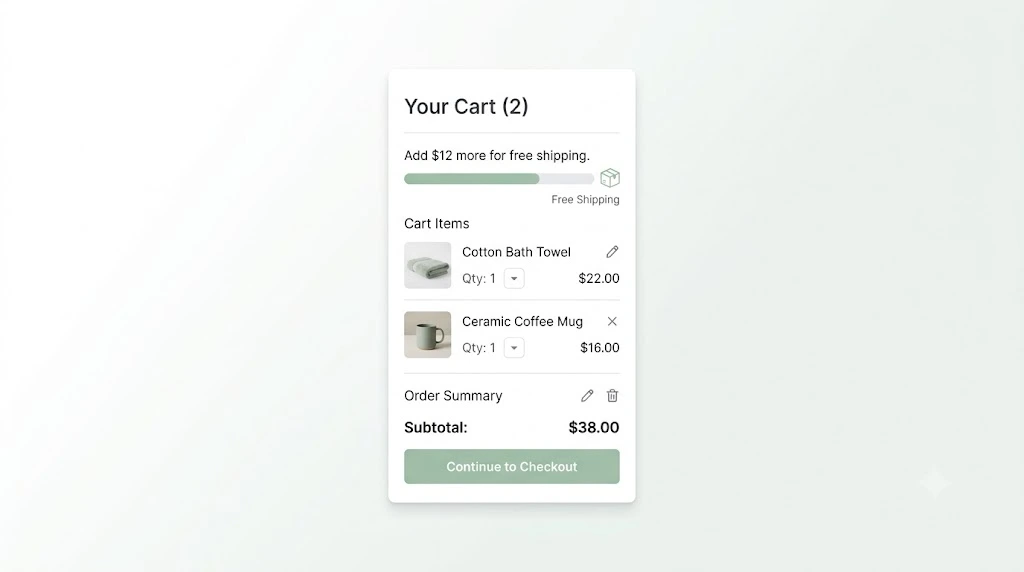
If a store-paid label now pushes small orders close to zero profit, look at who pays for shipping on those orders. A minimum order for free shipping is one option many stores test.
Case study: one brand’s free shipping threshold. The Shopify agency Zuper published a case study on a home and living brand it calls “Brand X” (the real client name is not disclosed). In 2019, the brand ran a four-day Black Friday sale with 20% off and free shipping on all orders. In 2020, it ran another four-day sale with 30% off and free shipping only on orders over €70.
Zuper reported that average order value almost doubled in the second sale, and the brand kept the €70 threshold afterwards.
Treat this as one illustrative case, not proof. The discount changed along with the threshold, the sales were a year apart, and Zuper itself says normal year-to-year growth could have played a part. The figures also appear only in charts. Your result could be different, so test a threshold on your own store before you rely on it.
Identify order types that fall below the target profit
Set a minimum profit per order. Then filter your last 90 days of orders and see which ones fall below it.
You will often find the same pattern: small baskets, heavy items or faraway zones. Once you know the pattern, the fix gets clearer. It might be a minimum order, a zone-based fee or a price change.
Common Mistakes When Assessing Shipping Cost Increases
A few errors show up again and again.
- Mixing up monthly totals with per-order impact. A $2,000 monthly loss feels abstract. A $2 loss per order tells you which products to fix.
- Treating revenue as profit. Sales can climb while profit slides. Always check what is left after costs.
- Comparing different product types without splitting them. A candle and a cast-iron pan do not ship alike. Average them together, and you will miss both problems.
- Treating international freight and domestic parcel costs as the same thing. They follow different pricing. An OECD working paper, The Impact of Container Shipping Costs on Import and Consumer Prices, looks at how container shipping costs pass through to import and consumer prices. It finds the effect is smaller once commodity imports are excluded. It is useful if you import stock by sea. It is not evidence about parcel rates from UPS, FedEx or USPS.
Frequently Asked Questions
How do rising shipping costs affect ecommerce profit margins?
They cut the profit on every order you ship. Unless you change prices or fees, the full increase comes out of your margin. Low-value and heavy orders usually lose the most.
How do you calculate shipping cost impact on profit?
Compare profit per order before and after the increase, keeping every other cost the same. Then multiply the difference by your monthly order volume.
How should a small store evaluate a shipping cost increase?
Start with your carrier invoices, not estimates. Split orders by value, weight and delivery zone. Then find the groups that fall below your target profit, and decide whether to change prices, fees or free shipping rules for those groups.
Conclusion
Rising shipping costs rarely arrive as one big shock. They arrive as many small ones, and each takes a slice of profit.
The good news is that this is easy to measure. Calculate profit per order, find the groups that fall short, and fix those first.
Your next step: Open your last 30 days of orders today. Add a column for actual shipping cost and one for profit per order. Within an hour, you will know exactly where shipping is costing you the most.