
Marketplace vs. Own Website: Which Is Better for Small Brands?
Last updated: October 30, 2026

You have a product people like. Now you need a place to sell it, and the marketplace vs. own website question is where most small brands get stuck.
Do you list on a marketplace like Etsy or Amazon, where shoppers already exist? Or do you build your own website and pull customers in yourself?
Both can work. Both can also quietly drain your profit if you pick for the wrong reasons.
In this guide, I’ll compare the two on the things that actually decide the outcome: cost, customer data, brand control and the work behind the scenes. You’ll also see a simple profit example, a brand’s story, and a checklist for choosing.
Marketplace vs. Own Website: Key Differences
The core difference is simple. On a marketplace, you rent space in someone else’s store. On your own website, you run the store.
Everything else flows from that. Traffic, fees, branding and customer data all change depending on who runs the shop.
What Is an Online Marketplace?
An online marketplace is a platform where many sellers list products in one place. Etsy, Amazon and eBay are common examples.
The platform brings the shoppers, handles checkout and sets the rules. You bring the products. In return, you pay fees and follow the platform’s policies.
What Is an Independent E-commerce Website?
An independent e-commerce website is a store you own and control. It runs on its own domain, with your design, your pricing and your checkout.
You might build it on a hosted platform or a self-managed one. Either way, the shop is yours. So is the job of getting people to visit it.
How Marketplace and Own Website Selling Differ
Think of a marketplace as a busy shopping mall. Foot traffic is built in, but your shop sits beside dozens of similar ones.
Your own website is a standalone shop on a quiet street. You control the look and the customer experience. But nobody walks in until you bring them.

Table 1: The core trade-off at a glance
| Comparison factor | Marketplace | Own website |
|---|---|---|
| Customer traffic | Existing platform traffic | Self-generated traffic |
| Brand control | Platform restrictions | Greater control |
| Fees | Marketplace fees | Website and payment costs |
| Marketing | Platform and external promotion | Mainly your own marketing |
A fuller side-by-side for Etsy appears later in this guide.
Selling on a Marketplace: Benefits and Limitations
A marketplace can be a faster way to get a first sale. The catch is that you trade control for convenience.
Benefits of Marketplace Selling
- Existing customer base. Shoppers already visit the platform with buying in mind.
- Often quicker setup. Speed depends on the platform and how ready your products are.
- Familiar checkout. A checkout buyers already know can reduce friction at purchase.
- Marketplace fulfilment options. Some platforms offer storage and shipping services, which can save time.
For a brand with no audience yet, that built-in traffic is hard to beat.
Limitations of Marketplace Selling
- Selling and transaction fees. Costs are charged on listings, sales or both, and they add up.
- Competition among sellers. Your product sits next to similar ones, often at lower prices.
- Platform policies. Rules, search rankings and fee structures can change without your input.
- Limited control over the customer relationship. The marketplace controls much of the buyer experience, and its rules limit how you can use customer information.
That last point matters more than most new sellers expect. We’ll come back to it.
Selling Through Your Own Website: Benefits and Limitations
Your own website gives you control over almost everything. It also hands you responsibility for almost everything.
Benefits of Having Your Own Website
- Brand identity and control. Your design, your story, your tone.
- Independent customer experience. No competitor listings beside your product.
- Direct customer relationships. Customers who sign up with their consent can hear from you after the sale.
- Flexible pricing and promotions. Run bundles, discounts and launches on your own terms.
Choosing the right platform is its own decision. If you’re weighing options, our guide to the best ecommerce platform for a small business covers the setup side in detail.
Limitations of Running Your Own Website
- Customer acquisition responsibility. No traffic arrives by default. You have to earn it through search, social, email or ads. Once you reach that stage, our guide on reducing customer acquisition costs for D2C brands is a good next read.
- Setup and maintenance costs. Domain, theme, apps and ongoing updates all cost money or time.
- Payment and fulfilment management. You set up payments, tax settings and shipping yourself.
- Building customer trust. A first-time buyer has never heard of you. Reviews, clear policies and good photos matter a lot.
Own Website vs. Etsy: Which Is Better for Small Sellers?
Etsy is where many small sellers start, so it deserves its own comparison. The right pick depends on your stage, your product and your margins.
Etsy Shop vs. Own Website
An Etsy shop can be quick to open, though approval and verification requirements can affect how fast you go live. Shoppers searching for handmade, vintage or craft items already visit Etsy, so you can get discovered without a marketing plan.
An own-website setup takes longer and needs traffic work. But the brand, the store design and the data you collect through your own checkout and sign-up forms are yours to manage. When people compare Etsy vs a personal website, this trade-off is usually the heart of it: speed and discovery on one side, control on the other.
Selling on Your Own Website vs. Etsy
On Etsy, buyers often remember the item more than the shop’s name. On your own site, the brand is the whole experience.
That difference shows up in repeat sales. A buyer who knows your site can come back directly. A buyer who found you through an Etsy search may discover a competitor next time.
Some sellers eventually decide to move. If that’s where you’re heading, here’s a walkthrough on migrating from Etsy to Shopify.
Etsy Fees vs. Independent Website Costs
Etsy’s fee structure is mostly pay-as-you-sell. Fees are country-dependent. For US sellers, the main charges are a listing fee of $0.20 per listing, a 6.5% transaction fee on the order total (shipping included), and payment processing of 3% plus $0.25. Other countries have different processing rates.
Etsy can also charge other fees, such as a one-time shop setup fee, Offsite Ads fees, currency conversion and taxes. The profit example later in this article uses the US rates above and leaves those extras out. Check the current numbers for your country on Etsy seller fees and taxes and Etsy payment processing fees.
An own website swaps those per-sale fees for a different cost mix: a monthly platform plan, payment processing, a domain, apps and marketing. The cost per order can be lower, but the fixed costs arrive before the sales do.
Which Option Suits Different Types of Sellers?
Etsy often suits new makers, sellers testing a product, and sellers with small catalogues. An own website often suits brands with a distinct identity, repeat buyers, or products that sit outside Etsy’s rules.
Many sellers end up using both. We’ll get to that.
Table 2: Etsy vs. own website
| Factor | Etsy | Own website |
|---|---|---|
| Initial setup | Fast: open a shop and list items. | Slower; domain, design, checkout and policies |
| Listing and transaction fees | Listing fee per listing; transaction fee on each sale | No marketplace fees; platform plan and payment costs instead |
| Customer discovery | Built-in search traffic | Must build through SEO, social, email or ads |
| Branding | Limited, within Etsy’s shop layout | Full control over look, story and experience |
| Customer information | Access and use are set by Etsy’s rules. | Greater control over data you collect, within privacy laws |
| Marketing responsibility | Shared with the platform | Mostly yours |
Marketplace vs. Own Website: Cost and Profit Comparison
A channel that looks cheaper can still leave you with less money. What matters is what’s left after every cost, not the fee headline.
Costs of Selling Through a Marketplace
Marketplace costs often vary with listing and sales activity, although some platforms also charge monthly selling-plan fees.
Typical items include listing fees, transaction or referral fees, payment processing, optional advertising and shipping. Amazon, for example, has both selling-plan fees and referral fees that depend on product category, so check the current details for your market on Amazon selling plans and referral fees.
Costs of Running Your Own Website
Website costs are lean fixed. You pay for a plan, a domain and tools, whether or not an order comes in.
Shopify pricing differs by country and billing period, so check the page for your market:
- US: Shopify pricing and plans
- India: Shopify India pricing
- UK: Shopify UK pricing
If you prefer a self-managed setup, WooCommerce’s core platform is free, but you choose and pay for hosting separately, and extensions can add annual costs. WooCommerce pricing and operating costs explain the details.
The biggest hidden cost is marketing. A marketplace shows your product to existing shoppers. Your own site has to pay, in time or money, for every first visit. Shipping is part of that picture too, so see how shipping costs affect e-commerce profit if your margins are thin.
How to Calculate Profit Across Both Selling Models
Use one formula for both channels:
Contribution = Revenue − Product cost − Platform fees − Payment processing − Marketing − Shipping − Other operating costs
Run it per order. Then compare.
Here is a hypothetical example. These are my own assumptions for illustration. They are not industry averages, so swap in your real numbers.
Assumptions
- Product price: $40. The buyer pays $6 in shipping, so revenue per order is $46.
- Product cost: $14. Your actual shipping and packaging cost: $7.
- Marketplace fees use the Etsy US rates mentioned above: 6.5% transaction fee on $46, and 3% + $0.25 processing. The $0.20 listing fee is charged when a listing is published or renewed, not on every order. For simplicity, I allocate it to one order, as if a single-item listing sells once.
- Own website: $39 is an assumed US monthly plan cost for this example, not a global Shopify price. It is spread over 50 orders ($0.78 per order). Payment processing of 2.9% + $0.30 is also an assumption for a platform’s built-in payments. Third-party payment providers can add extra transaction fees.
- Marketing: $3 per order on the marketplace (platform ads) and $12 per order on your own site (acquiring a new customer).
- Other operating costs ($0.50 marketplace, $1.00 own website) are illustrative guesses for small tools and supplies, plus a share of a domain and apps on the own site.
- Not included: shop setup fees, Offsite Ads fees, taxes, currency conversion and other optional charges.
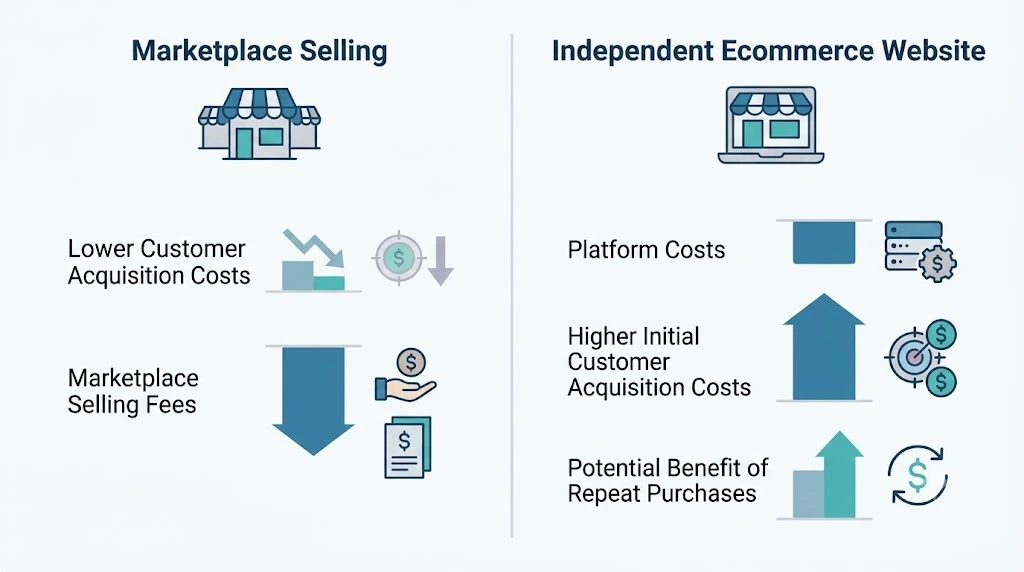
Table 3: Hypothetical cost comparison (per order)
| Cost component | Marketplace | Own website |
|---|---|---|
| Revenue (price + shipping paid) | $46.00 | $46.00 |
| Product cost | $14.00 | $14.00 |
| Selling/platform fees | $3.19 | $0.78 |
| Payment processing | $1.63 | $1.63 |
| Marketing | $3.00 | $12.00 |
| Shipping | $7.00 | $7.00 |
| Other operating costs | $0.50 | $1.00 |
| Contribution after listed costs | $16.68 | $9.59 |
In this example, the marketplace leaves about $7 more on a first order. The own website looks weaker because of the assumed $12 acquisition cost.
Now change one assumption. If a returning customer orders from your own site after an email (assumed $2 marketing cost), the same order leaves $19.59. That is more than the marketplace order in this example.
Where the Break-Even Point Falls
Using the same assumptions, a customer who buys once on your own site leaves you $9.59. Each repeat order after that leaves $19.59. Compare that with $16.68 for every marketplace order:
- After 2 orders from one customer: $29.18 on your own site vs. $33.36 on the marketplace.
- After 3 orders: $48.77 vs. $50.04. Still slightly behind.
- After 4 orders: $68.36 vs. $66.72. The own website pulls ahead.
So in this example, your own site starts winning around a customer’s fourth order. This assumes the same customer would keep ordering at the same contribution on the marketplace, and that repeat orders on your site cost only $2 each to win. Both are simplifications. If your customers rarely come back, the marketplace stays ahead.
Whether that happens in real life depends on whether customers come back. Your actual result will change with your product margin, acquisition cost, payment provider, repeat-purchase rate and platform fees. Treat this as a template for your own numbers, not a prediction.
Selling From India: A Quick Note
The example above uses US dollars and Etsy US fees because those rates are public and easy to check. If you sell from India, the same logic applies, but the inputs change.
- Marketplaces. Amazon India, Flipkart and Meesho each have their own commission, fixed fee and shipping charge structures, and these vary by product category. Check each platform’s current seller fee page rather than reusing the numbers here.
- Etsy from India. Etsy’s payment processing fee for sellers with an Indian bank account is 5% + 25 INR per order, and Etsy also lists a Regulatory Operating fee for sellers in India. See Etsy payment processing fees for the current rate.
- Own website. Compare plan pricing on Shopify India pricing, and check payment gateway charges from Indian providers.
- Other costs. Add GST, returns and cash-on-delivery handling, which can change contribution per order a lot in India.
- Selling abroad. If you plan to reach overseas buyers through Etsy or your own site, include currency conversion and international shipping in your per-order maths.
Run the contribution formula with your own rupee figures. The comparison will tell you more than any average.
Customer Ownership and Brand Control: Marketplace vs. Own Website
Fees are visible. Control over the customer experience is the part that quietly shapes your business over five years.
Access to Customer Information
On a marketplace, you receive the order details you need to fulfil a sale. What you may do with buyer information beyond that depends on the platform’s rules and the privacy laws that apply to you.
On your own site, you decide what to collect and how to use it. That works as long as you ask for appropriate consent, keep the data secure and follow the privacy laws in your market. Done properly, email addresses, purchase history and product preferences become real business assets.
Building Direct Customer Relationships
A direct relationship means you can send a thank-you note, a restock alert or a launch announcement to customers who signed up on your own site. Marketing emails need appropriate consent and a clear way to unsubscribe, and you are responsible for keeping customer data secure.
That is how a one-time buyer becomes a regular. It is also how you lower your dependence on any single channel.
One caution. Follow each marketplace’s rules on buyer communication, email marketing and directing customers off-platform. Don’t assume you can add marketplace buyers to your own marketing list. For Etsy, read Etsy’s off-platform transactions policy before you plan any outreach.
Branding and Shopping Experience
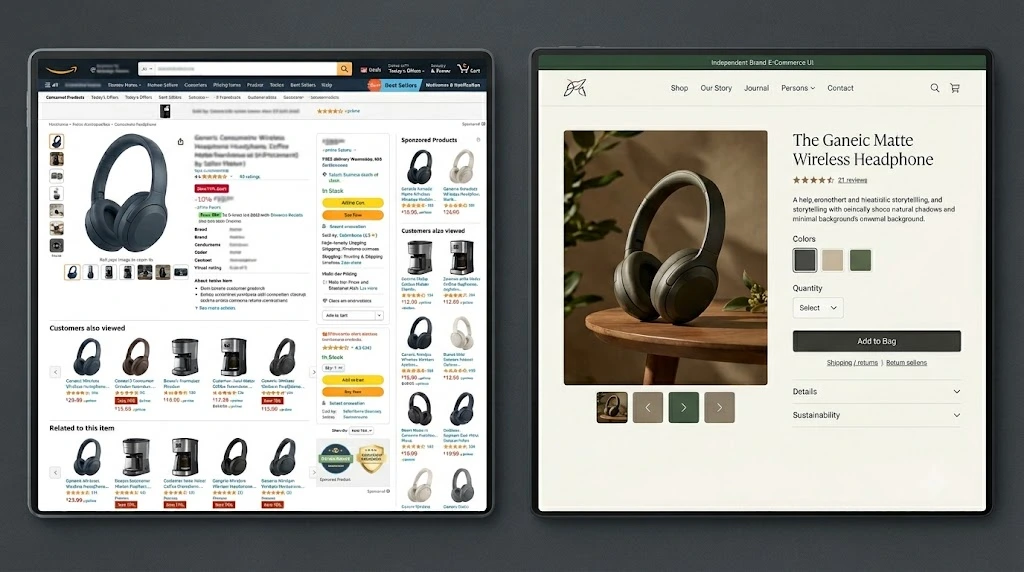
Marketplace shop pages look similar by design. Your photos and descriptions matter, but the frame around them isn’t yours.
Your own website lets you control layout, post-purchase emails and tone. For brands where identity is part of the product, that control is a real advantage.
Understanding the Direct-to-Consumer Sales Model
The direct-to-consumer sales model means selling your products straight to buyers through channels you own, without a retailer or marketplace in the middle.
A good direct to consumer sales strategy starts small. Collect email sign-ups on your own site from day one, with consent. Offer something worth coming back for. Track which channels bring buyers who return.
You can use marketplaces to find demand and still treat D2C as your long-term plan.
Should Small Brands Sell on Both Marketplaces and Their Own Websites?
Often, yes, but not at the same time and not on day one. The smartest sellers treat the two channels as different jobs.
When to Start With a Marketplace
Start with a marketplace if you’re testing a product, have a small budget, or have no audience yet. A marketplace gives you demand data without a big upfront bill.
You’ll learn which items sell, which photos work and what buyers ask before purchase.
When to Build Your Own Website
Build your own website once you have proof that the product sells and you want more control over the brand and the customer experience.
Here is one example. Walnut Studiolo, a leather goods brand, began selling on Etsy in 2009. According to a 2015 Shopify blog interview with the founders, they decided in 2012 to move beyond Etsy and build their own Shopify site, so they could create their own content, connect directly with customers and build their brand. The brand continued selling on Etsy, but its share of sales from Etsy versus Shopify shifted over time in favour of its own website as the brand became established.
Two caveats. This is a Shopify-published interview, so treat it as one brand’s path, not independent proof that the approach works for every seller. And Etsy was where this brand found its first customers, so the marketplace played a real role in the story.
Source: Selling Handmade Items on Shopify: Tips for Makers (Shopify)
How to Manage Both Sales Channels Together
Selling in two places is manageable with a few habits:
- Keep one master inventory sheet so you never oversell.
- Use consistent product names, photos and pricing rules.
- Read each marketplace’s policy on buyer communication and off-platform transactions before you promote your own site in messages or order inserts. Rules differ by platform.
- Review each channel’s contribution per order every month.
Stock accuracy is the part that breaks first. Our guide to ecommerce inventory forecasting shows how to plan for several channels at once.
Table 4: Channel selection by business situation
| Business situation | Suggested approach |
|---|---|
| New seller with limited budget | Evaluate marketplace first |
| Established product demand | Consider own website |
| Strong independent brand | Prioritize owned store |
| Existing marketplace sales | Evaluate adding own website |
| Limited operational capacity | Avoid expanding to too many channels |
How to Choose the Right Selling Model for Your Small Brand
The right choice is the one that fits your numbers and your capacity right now. Work through these five checks.
Evaluate Your Available Budget
Marketplaces need less money up front. Websites need setup money and a marketing budget. Decide how many months you can fund before sales pick up.
Understand Your Product Margins
Low-margin items struggle with high customer acquisition costs. High-margin or repeat-purchase items can absorb them. Run the contribution formula from earlier before deciding.
Assess Your Customer Acquisition Capabilities
Be honest about your strengths. If you enjoy content, SEO or email, an own website will reward that. If you’d rather focus on making products, a marketplace may suit you longer.
Consider Operational Capacity
Each new channel adds orders, messages and stock tracking. If you’re already stretched, adding a channel can hurt quality.
Set Short-Term and Long-Term Business Goals
A short-term goal might be “get 100 orders and learn what sells.” A long-term goal might be “build a brand with its own customer list.” Different goals can justify different channels at different times.
A starting point, not a law: many small brands use marketplaces to find demand, then build their own website to deepen the relationship with the customers they win.
Frequently Asked Questions
Is It Better to Have a Website or Etsy?
It depends on your stage. Etsy is better for fast discovery and low upfront effort. A website is better for brand control and building your own customer list. Many sellers start on Etsy, then add a website once demand is proven.
Is Selling on Etsy Better Than Having Your Own Website?
Not always. Etsy is easier to start with because buyers already search there. But fees apply on every sale, and Etsy’s rules shape how you can use buyer information. Your own website costs more effort early and gives more control later.
Can a Small Business Sell on Both Etsy and Its Own Website?
Yes. Many do. Keep inventory in one place, keep branding consistent and check each platform’s rules on buyer communication and directing customers elsewhere. Start with one channel, then add the second when you can handle the extra work.
Is a Direct-to-Consumer Website More Profitable?
Not automatically. A D2C site avoids marketplace fees, but it adds platform, marketing and operating costs. It tends to become more profitable when customers return, because repeat orders usually cost less to win.
Do Small Brands Need Their Own E-commerce Website?
Not on day one. If you’re testing a product, a marketplace may be enough. But if you want to build a brand, collect your own customer data with consent and set your own rules, an own website becomes worth the investment.
Your Next Step
Pick one product. Run it through the contribution formula for both channels using your real fees and your real shipping cost.
If the numbers favour the marketplace, test there for 30 days. If they favour your own site, build a simple store and start collecting email sign-ups from your first visitor.
Either way, write the numbers down. They make the decision far less emotional.
Want more practical e-commerce guides for small brands? Read our next guide on choosing the right ecommerce platform.